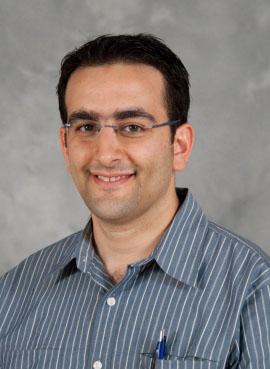
Turgay Ayer

Turgay Ayer's profile picture
tayer3@mail.gatech.edu

Turgay Ayer is the Virginia C. and Joseph C. Mello Chair and a professor in the H. Milton Stewart School of Industrial and Systems Engineering at Georgia Tech. Ayer also serves as the research director for healthcare analytics and business intelligence in the Center for Health & Humanitarian Systems at Georgia Tech and holds a courtesy appointment at Emory Medical School.

His research focuses on healthcare analytics and socially responsible business analytics with a particular emphasis on practice-focused research. His research papers have been published in top tier management, engineering, and medical journals, and covered by popular media outlets, including the Wall Street Journal, Washington Post, U.S. News, and NPR.

Ayer has received over $2.5 million grant funding and several awards for his work, including an NSF CAREER Award (2015), first place in MSOM Responsible Research in Operations Management (2019), first place in the MSOM Best Practice-Based Research Competition (2017), INFORMS Franz Edelman Laureate Award (2017), and Society for Medical Decision Making Lee Lusted Award (2009).

Ayer serves an associate editor for Operations Research, Management Science, and MSOM, and is a past president of the INFORMS Health Application Society. He received a B.S. in industrial engineering from Sabanci University in Istanbul, Turkey, and his M.S. and Ph.D. degrees in industrial and systems engineering from the University of Wisconsin–Madison.

Virginia C. and Joseph C. Mello Chair
Professor, Industrial and Systems Engineering
Research Director of Business Intelligence and Healthcare Analytics, Center for Health and Humanitarian Systems
Phone
404-385-6038
Additional Research

Socially Responsible Operations; Practice-focused Research; Healthcare Analytics

Google Scholar
https://scholar.google.com/citations?hl=en&user=BY9oaaoAAAAJ&view_op=list_works&sortby=pubdate

Christopher Rozell

Christopher Rozell's profile picture
crozell@gatech.edu
Professor; School of Electrical and Computer Engineering
Director; Sensory Information Processing Lab
Phone
404.385.7671
Office
Centergy One 5218
Additional Research

Biological and computational vision Theoretical and computational neuroscience High-dimensional data analysis Distributed computing in novel architectures Applications in imaging, remote sensing, and biotechnology Dr. Rozell's research interests focus on the intersection of computational neuroscience and signal processing. One branch of this work aims to understand how neural systems organize and process sensory information, drawing on modern engineering ideas to develop improved data analysis tools and theoretical models. The other branch of this work uses recent insight into neural information processing to develop new and efficient approaches to difficult data analysis tasks.

Google Scholar
http://scholar.google.com/citations?user=JHuo2D0AAAAJ&hl=en&oi=ao

Munmun De Choudhury

Munmun De Choudhury's profile picture
munmund@gatech.edu

Munmun De Choudhury is a Professor at the School of Interactive Computing in Georgia Institute of Technology. She is renowned for her groundbreaking contributions to the fields of computational social science, human-computer interaction, and digital mental health. Through fostering interdisciplinary collaborations across academia, industry, and public health sectors. De Choudhury and her collaborators have contributed significantly to advancing the development of computational techniques for early detection and intervention in mental health, as well as in unpacking how social media use benefits or harms mental well-being. De Choudhury's contributions have been recognized worldwide, with significant scholarly impact evidenced by numerous awards like induction into the SIGCHI Academy and the 2023 SIGCHI Societal Impact Award. Beyond her academic achievements, She is a proactive community leader, a persistent contributor to policy-framing and advocacy initiatives, and is frequently sought for expert advice to governments, and national and international media.


Professor in the School of Interactive Computing; Director of Social Dynamics and Well-Being Laboratory; Co-Lead of Children's Healthcare of Atlanta Pediatric Technology Center at Georgia Tech's Patient-Centered Care Delivery
Phone
4043858603
Additional Research
  • Social Media
  • Social Computing
  • Computational Social Science
  • Mental Health
  • Natural Language

Christopher Wiese

Christopher Wiese's profile picture
ChrisWiese@gatech.edu

My research focuses on three major areas: (a) understanding and improving worker well-being, (b) temporal dynamics in team contexts, and (c) research methods. Collectively, my research seeks to improve our understanding of optimal human functioning more generally, across time, and within specific contexts (e.g., organizational, teams).

Assistant Professor
University, College, and School/Department

Josiah Hester

Josiah Hester's profile picture
josiah@gatech.edu

Josiah Hester works broadly in computer engineering, with a special focus on wearable devices, edge computing, and cyber-physical systems. His Ph.D. work focused on energy harvesting and battery-free devices that failed intermittentently. He now focuses on sustainable approaches to computing, via designing health wearables, interactive devices, and large-scale sensing for conservation. 
   
His work in health is focused on increasing accessibility and lowering the burden of getting preventive and acute healthcare. In both situations, he designs low-burden, high-fidelity wearable devices that monitor aspects of physiology and behavior, and use machine learning techniques to suggest or deliver adaptive and in-situ interventions ranging from pharmacological to behavioral. 
   
His work is supported by multiple grants from the NSF, NIH, and DARPA. He was named a Sloan Fellow in Computer Science and won his NSF CAREER in 2022. He was named one of Popular Science's Brilliant Ten, won the American Indian Science and Engineering Society Most Promising Scientist/Engineer Award, and the 3M Non-tenured Faculty Award in 2021. His work has been featured in the Wall Street Journal, Scientific American, BBC, Popular Science, Communications of the ACM, and the Guinness Book of World Records, among many others.

BBISS Faculty Director for Civic Innovation and AI
Catherine M. and James E. Allchin Early Career Professor
Professor
Director, Ka Moamoa – Ubiquitous and Mobile Computing Lab
Office
TSRB 246

David Peeler

David Peeler's profile picture
davidpeeler@gatech.edu

David Peeler is a research scientist and a recent graduate from Georgia Tech having completed a bachelor's degree in computer science in May 2022. His research interests lie in machine learning, mobile (Android) development, and STEM education. Currently, he is supporting the TechSAge D2 fall detection project detecting and reporting user falls from wheelchairs. He is also supporting STEM @ GTRI's rural education project giving 1000+ hours of direct instruction and curriculum development of different topics of computer science to high schoolers.

Research Scientist

Jon Duke

Jon Duke's profile picture
jon.duke@gatech.edu

Dr. Jon Duke is the director of the Center for Health Analytics and Informatics at the Georgia Tech Research Institute (GTRI) and a principal research scientist at the School of Interactive Computing in the College of Computing. He began working at Georgia Tech in 2016. His career before Tech was entirely in medical environments, both as a physician and a researcher.  

At Georgia Tech his research focuses on advancing techniques for identifying patients of interest from diverse data sources with applications spanning research, quality, and clinical domains. 

Dr. Duke has led over $21 million in funded research for industry, government, and foundation partners. Dr. Duke’s research focuses on advancing techniques for identifying patients of interest from diverse data sources with applications spanning research, quality, and clinical domains.  He led the Merck-Regenstrief Partnership in Healthcare Innovation and was a founding member of OHDSI, an open-source international health data analytics collaborative.  In addition to numerous peer-reviewed publications, his work has been featured in the lay media including the New York Times, NPR, and MSNBC.  Dr. Duke completed his medical degree at Harvard Medical School and a master's in human-computer interaction at Indiana University.

Director of the Center for Health Analytics and Informatics at the Georgia Tech Research Institute
Principal Research Scientist

Brad Fain

Brad Fain's profile picture
brad.fain@cacp.gatech.edu

Brad Fain, principal research scientist at the Georgia Tech Research Institute (GTRI) and at the Center for Advanced Communications Policy (CACP), has been appointed as executive director of CACP. The appointment was announced on January 2, 2019 by Ivan Allen College of Liberal Arts Dean Jacqueline Royster.

Housed in the Georgia Tech School of Public Policy, CACP focuses on key issues that influence the development, implementation and adoption of communications technologies. CACP work includes assessment of policy issues and production of regulatory filings, identification of future options for innovation, and articulation of a clearer vision of the ever-changing technology landscape. The Center’s research addresses a wide range of advanced communications policy issues and related technology applications, particularly in the wireless and new technology arenas.

Fain brings to bear more than twenty-five years of experience in human performance. He directs Georgia Tech’s HomeLab research initiative and leads a team that is pioneering research into issues and products design to assist with successful aging in place. He joined Georgia Institute of Technology in 1992 and has extensive experience developing technologies, evaluation processes, and curriculum in the field of accessible design. He has also led or assisted in a variety of research programs on the design of fixed and rotary wing crew interfaces, and he currently leads a project to build a virtual reality usability testbed for first responder technologies enabled by FirstNet for the National Institute for Standards and Technology (NIST). He has performed over one hundred accessibility evaluations for national and international customers in twenty projects. He has executed over two hundred consumer product evaluation projects. He pioneered the development of Consumer Product Integration (CPI) as a design process for the realization of products with universal design features.

Fain led the National Council on Disability’s (NCD) universal design research program. The focus of the research program was to determine the impact of Section 508 of the Rehabilitation Act on the design and procurement of electronic and information technologies. Fain’s report contained universal design policy recommendations that were endorsed by the NCD and sent to the president of the United States for consideration. He conceived and led the development of an information portal containing information pertaining to the design and procurement of accessible electronic and information technologies. The Accessibility Assistant (http://accessibility.gtri.gatech.edu) is the culmination of eight years of accessibility research at Georgia Tech and serves over 1,500 visitors monthly.

Fain has also led the technical portion of the EAC’s Military Heroes Initiative to search for new technologies that would allow recently wounded soldiers to place a private and secure vote. He served as the technical director of the EAC’s Accessible Voting Technology Initiative (AVTI) to develop technologies solutions that facilitate accessible voting for the general population. The AVTI resulted in the development of a voting system test bed used to conduct accessibility research for ballot design and novel hardware design. He also led a NIST research grant to determine best practices for quantifying and certifying the accessibility and usability of new voting systems. Fain served as the technical director for the Information Technology and Technical Assistance Training Center (ITTATC) project. He led the needs assessment and technical assistance portions of the ITTATC project and has developed materials to support accessibility curriculum development efforts. He led the development of the Accessibility Evaluation Facility to support independent third-party evaluations of electronic and information technology accessibility and usability. In addition, he led the development of training materials to educate designers and accessibility specialists in the measurement of accessibility. In 2004, Fain modified the AEM to measure ease of use for special populations and, as a result, GTRI was named as the national test lab for the Arthritis Foundation’s Ease of Use Commendation Program.

Executive Director, Center for Advanced Communications Policy
Principal Research Scientist, GTRI

Andrea Grimes Parker

Andrea Grimes Parker's profile picture
andrea@cc.gatech.edu

Andrea Grimes Parker is an Associate Professor in the School of Interactive Computing at Georgia Tech. She is also an Adjunct Associate Professor in the Rollins School of Public Health at Emory University and at Morehouse School of Medicine. Dr. Parker holds a Ph.D. in Human-Centered Computing from Georgia Tech and a B.S. in Computer Science from Northeastern University. She is the founder and director of the Wellness Technology Lab at Georgia Tech. Her interdisciplinary research spans the domains of human-computer interaction and public health, as she examines how social and interactive computing systems can be designed to address health inequities. Dr. Parker has published widely in the space of digital health equity and received several best paper honorable mention awards for her research. Her research has been funded through awards from the National Science Foundation, the National Institutes of Health, the Aetna Foundation, Google, and Johnson & Johnson. 

Associate Professor