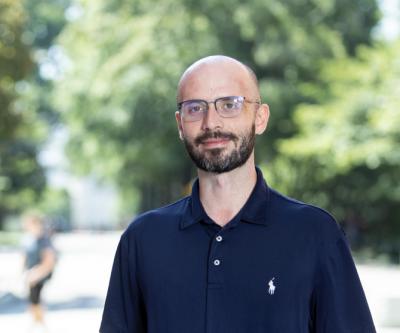
David White

David White's profile picture
drwhite@cc.gatech.edu

David White leads the Office of Academic Administration, which provides academic advising for the BS and MS degrees in Computer Science. Mr. White coordinates the schedule of classes with the College's three Schools and the Division of Computing Instruction, and works with the College's Technology Services Organization to provide student information systems. He also frequently represents the College on academic initiatives, including the Institute's steering committee for Complete College Georgia.

As Executive Director of the Online MS in Computer Science, Mr. White works closely with the faculty, many Georgia Tech administrative departments, and Udacity to ensure the goals and responsibilities of the program are met.

Mr. White came to Georgia Tech in 2001 as a student in the MS program in Human-Computer Interaction. He began working full time for the College of Computing in 2004 as academic advisor for the MS in Human-Computer Interaction and the BS in Computational Media. Since that time he has also served as Academic Programs Coordinator for the School of Interactive Computing and Director of Graduate Programs for the College.

Mr. White has a BA in English from The University of Tennessee at Knoxville and the MS in Human-Computer Interaction from Georgia Tech.

Executive Director of OMSCS
Associate Dean for Academic Affairs
University, College, and School/Department

Wayne Li

Wayne Li's profile picture
wayne.li@design.gatech.edu

Wayne K. Li is the James L. Oliver Professor, which is a joint position between the Colleges of Design and Engineering. Through classes and the Innovation and Design Collaboration (IDC), he leads joint teaching initiatives and advances interdisciplinary collaboration between mechanical engineering and industrial design. Endowed by School of Industrial Design alumnus James L. Oliver, II (BS ID 1965, ME 1967), the Oliver professor embodies the idea of "multidisciplinary." Li teaches students that design behavior bridges the language and ideological gap between engineering and design. Li’s research areas include ethnographic research, multidisciplinary online education, and human-machine interaction in transportation design.  

Previously, Li led innovation and market expansion for Pottery Barn seasonal home products, was an influential teacher in Stanford University’s design program where he taught visual communication and digital media techniques, led “interface development” in Volkswagen of America’s Electronics Research Laboratory, and developed corporate brand and vehicle differentiation strategies at Ford Motor Company.

He received a Master of Science in Engineering from Stanford University, and undergraduate degrees in Fine Arts in Design and Mechanical Engineering from the University of Texas at Austin.

Professor of the Practice of Design and Engineering
University, College, and School/Department

Jason Borenstein

 Jason Borenstein's profile picture
jason.borenstein@pubpolicy.gatech.edu

Jason Borenstein, Ph.D., is the Director of Graduate Research Ethics Programs and Associate Director of the Center for Ethics and Technology. His appointment is divided between the School of Public Policy and the Office of Graduate Studies. He is also Affiliated Faculty at the Institute of Robotics and Intelligent Machines (IRIM). Dr. Borenstein is an associate editor of the journal Science and Engineering Ethics, a Founding Editor of the journal AI and Ethics, co-editor of the Stanford Encyclopedia of Philosophy’s Ethics and Information Technology section, and an editorial board member of the journal Accountability in Research. He is also Editor for Research Ethics for the National Academy of Engineering's Online Ethics Center for Engineering and Science. He was the Founder and formerly Editor-in-Chief of the Journal of Philosophy, Science & Law. Dr. Borenstein’s research interests include bioethics, engineering ethics, robot ethics, and research ethics.

He is currently a Co-Principal Investigator (Co-PI) on a five-year project funded by the National Science Foundation (NSF) entitled "Institutional Transformation: The Role of Service Learning and Community Engagement on the Ethical Development of STEM Students and Campus Culture". He is a Co-PI on the NSF-funded “Fairness, Ethics, Accountability, and Transparency (FEAT) in Computer and Information Science and Engineering Workshop” that took place August 29 and 30, 2019 on Georgia Tech's campus. He is also a Co-PI on the NSF-funded project “Do the Right Thing: Competing Ethical Frameworks Mediated by Moral Emotions in Human-robot Interaction" and on the NSF-funded project "EAGER: Pilot Study on Bias and Trust in AI Systems". In addition, he is a Co-PI on the Mozilla Responsible Computer Science Challenge funded project “Cultivating an Ethics-Inclusive Mindset Through Role Play in Undergraduate Computer Science Courses”. His work has appeared in numerous professional journals including AI & Society, Communications of the ACM, Science and Engineering Ethics, Ethics and Information Technology, IEEE Transactions on Technology and Society, IEEE Technology & Society Magazine, Accountability in Research, and the Columbia Science and Technology Law Review.

Dr. Borenstein’s teaching and research interests include robot & artificial intelligence ethics, engineering ethics, research ethics/RCR, and bioethics.

Director, Graduate Research Ethics Programs
Principal Academic Professional
Research Focus Areas

Athanassios Economou

Athanassios Economou's profile picture
thanos@gatech.edu

Athanassios (Thanos) Economou is Professor at the School of Architecture in the College of Design, and Adjunct Professor at the School of Interactive Computing at Georgia Institute of Technology. Dr. Economou’s teaching and research are in the areas of shape grammars, computational design, computer-aided design and design theory, with over sixty published papers in these areas. He is the Director of the Shape Computation Lab, a research group that explores how the visual nature of shape can be formally implemented with new technologies to enable new paradigms in visual computation, design automation, creative design and digital heritage. Recent projects include the Shape Machine, a new computational technology that allows shape matching in CAD systems, and Courtsweb, the most significant visual database on Federal Courthouses, sponsored by GSA and US.Courts. Design projects from his studios at Georgia Tech have received prestigious awards in international and national architectural competitions. He has been invited to give talks, seminars, and workshops at several universities including MIT, Harvard, TU Vienna, U. Michigan, KAIST, Chiao Tung U Taiwan, Emory, Seoul National U, Cambridge U, Tsinghua U, UCLA, NTUA, U.Thessaly, U.Aegean, among others. Dr. Economou holds a Diploma in Architecture from NTUA, Athens, Greece, an M.Arch from USC, and a PhD in Architecture from UCLA.

Professor of Architecture, College of Design
Director, Shape Computation Lab

Animesh Garg

Animesh Garg's profile picture
animesh.garg@gatech.edu

Animesh Garg is a Stephen Fleming Early Career Assistant Professor at School of Interactive Computing at Georgia Tech. He leads the People, AI, and Robotics (PAIR) research group. He is on the core faculty in the Robotics and Machine Learning programs. Animesh is also a Senior Researcher at Nvidia Research. Animesh earned a Ph.D. from UC Berkeley and was a postdoc at the Stanford AI Lab. He is on leave from the department of Computer Science at University of Toronto and CIFAR Chair position at the Vector Institute.

Garg earned his M.S. in Computer Science and Ph.D. in Operations Research from UC, Berkeley. He worked with Ken Goldberg at Berkeley AI Research (BAIR). He also worked closely with Pieter Abbeel, Alper Atamturk & UCSF Radiation Oncology. Animesh was later a postdoc at Stanford AI Lab with Fei-Fei Li and Silvio Savarese.

Garg's research vision is to build the Algorithmic Foundations for Generalizable Autonomy, that enables robots to acquire skills, at both cognitive & dexterous levels, and to seamlessly interact & collaborate with humans in novel environments. His group focuses on understanding structured inductive biases and causality on a quest for general-purpose embodied intelligence that learns from imprecise information and achieves flexibility & efficiency of human reasoning.

Assistant Professor
Additional Research

Robot Learning3D Vision and Video ModelsCausal InferenceReinforcement LearningCurrent Applications: Mobile-Manipulation in Retail/Warehouse, personal, and surgical robotics

Google Scholar
https://scholar.google.com/citations?hl=en&user=zp8V7ZMAAAAJ&view_op=list_works&sortby=pubdate

Kala Jordan

Kala Jordan's profile picture
kala.jordan@gatech.edu

Kala Jordan, research scientist II at the Institute for People and Technology (IPaT), brings a wealth of academic achievement and professional expertise to her role. She holds a bachelor’s degree in biology with a specialized focus on cellular, molecular, and developmental biology, coupled with a master of science in health informatics, Kala's educational background underscores her multidisciplinary approach to research. Her professional endeavors are underscored by a diverse spectrum of research interests, spanning from healthcare system innovation, STEM education, and data analysis. At present, Kala is immersed in supporting the AI Institute for Collaborative Assistance and Responsive Interaction for Networked Groups (AI-CARING) project. In this capacity, she spearheads studies aimed at bolstering the development of personalized collaborative AI systems tailored to enhance the quality of life for older adults. In addition to her pivotal role within the AI-CARING project, Kala actively contributes to STEM @ GTRI’s rural education initiative. Here, she assumes a multifaceted role, providing direct instruction and contributing to curriculum development in various facets of computer science for high school students. Through, her multifaceted research efforts and educational outreach, Kala Jordan exemplifies a consummate professional dedicated to leveraging cutting-edge technology and empirical insights to address pressing societal challenges and empower individuals through education and innovation.

Research Scientist II

Shaowen Bardzell

Shaowen Bardzell's profile picture
sbardzell@cc.gatech.edu

Shaowen Bardzell is Chair and Professor at Georgia Institute of Technology's School of Interactive Computing.

Bardzell holds a Ph.D. in Comparative Literature from Indiana University and pursues a humanistic research agenda within the research and practice of Human Computer Interaction (HCI). A common thread throughout her work is the exploration of the contributions of feminism, design, and social science to support technology’s role in social change. Recent research topics include care ethics and feminist utopian perspectives on IT, research through design, women’s health, posthumanist approaches to sustainable design, computational agriculture and food justice, and cultural and creative industries in Asia. Her work is supported by the National Science Foundation, Intel Corporation, and the Mellon Foundation, among others.

She is the co-editor of Critical Theory and Interaction Design (MIT Press, 2018) and co-author of Humanistic HCI (Morgan & Claypool, 2015). 

Professor and Chair of School of Interactive Computing

Jill Gambill

Jill Gambill's profile picture
jillgambill@gatech.edu

Jill Gambill is the Executive Director and Senior Research Associate for the Coastal Equity and Resilience Hub in the Institute of People and Technology (IPaT) at the Georgia Institute of Technology. Gambill previously spent over 12 years at the University of Georgia, where she most recently served as Coastal Resilience Specialist and Public Service Associate for Marine Extension and Georgia Sea Grant. In this role, she worked with vulnerable coastal communities to equitably plan for and respond to flooding from storm surge and sea level rise.

In addition to her faculty appointment with Marine Extension and Georgia Sea Grant, she is affiliate faculty with the Institute for Resilient Infrastructure Systems, Institute for Women’s Studies and Department of Marine Sciences at the University of Georgia and Department of Environmental Health at Emory University.

Gambill is co-chair of the Georgia Coastal Hazards Community of Practice, a member of the Practitioner Consultation Board for the NASA Sea Level Change Science Team and part of the leadership team for the Georgia Climate Project, a statewide initiative aimed at strengthening research and communication on the impacts and solutions of climate change in Georgia. Gambill holds a B.A. in Philosophy from Cardiff University in Wales, an M.A. in Peace and Conflict Studies from the University of Sydney in Australia and earned her Ph.D. in Geography and Integrative Conservation at the University of Georgia. She is a nationally accredited Certified Floodplain Manager.

Executive Director, Coastal Equity and Resilience Hub
Senior Research Associate
Phone
706.542.3463

Karen J. Head

Karen J. Head's profile picture
khead@gatech.edu

Dr. Karen Head (Ph.D. University of Nebraska, M.A. University of Tennessee, B.A. Oglethorpe University, A.A. DeKalb College) was previously the Associate Chair and Professor in Georgia Tech's School of Literature, Media, and Communication and Executive Director of the Institute-wide Communication Center. She has been at Georgia Tech since 2004.

In 2020, she was named the inaugural Poet Laureate of Fulton County, Georgia.

She is also the editor of Atlanta Review and the immediate past editor of Southern Discourse in the Center: A Journal of Multiliteracy and Innovation.

On a more unusual note, she is currently the Poet Laureate of Waffle House—a title that reflects an outreach program to bring arts awareness to rural high schools in Georgia, which has been generously sponsored by the Waffle House Foundation.

She has published five books of poetry (Lost on Purpose, Sassing, My Paris Year, On Occasion: Four Poets, One Year, and Shadow Boxes) and exhibited acclaimed digital poetry projects. Since 2006, she has been a Visiting Scholar at Technische Universität-Dortmund, Germany, where she serves as primary consultant for their academic tutoring center.

Her research focuses on higher education rhetoric, sustainable and innovative pedagogy and space design, communication theory and pedagogical practice, especially the implementation and development of writing centers, writing program administration, and multidisciplinary communication. Her book, Disrupt This! MOOCs and the Promises of Technology was published by University Press of New England in 2017.

In 2012-13, she was awarded a Georgia Tech Fund for Innovation in Research and Education Grant. Head's classes center on analyzing, critiquing, evaluating, and creating a variety of texts that demonstrate an understanding of audience and adaptation of multimodal rhetorical strategies and tools. Students and colleagues consistently rank her teaching as excellent. In 2012-13, she won the CETL/BP Junior Faculty Teaching Award. In 2019, she was honored with the Georgia Tech Outstanding Service Award.

Adjunct Professor