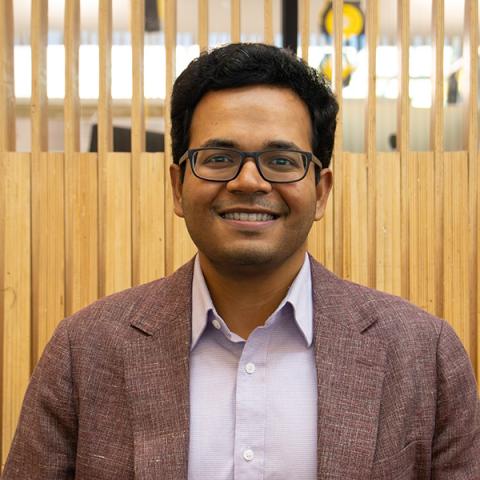
Rounaq Basu

Rounaq Basu
rounaq@gatech.edu

Rounaq Basu is an Assistant Professor in the School of City and Regional Planning at Georgia Tech, with an affiliation to the Center for Urban Resilience and Analytics. He holds a Ph.D. in Urban Science and Planning, as well as dual master’s degrees in Transportation and City Planning, from MIT and a Bachelor’s in Civil Engineering from IIT Bombay with a focus on transportation engineering. 

Basu’s research centers on sustainable urban mobility, with a particular focus on reducing auto-dependence in metropolitan areas. His work integrates urban analytics, econometrics, and agent-based microsimulations to inform policies that promote transportation equity, sustainable growth, and better urban systems. He is passionate about using these diverse tools to create more resilient and equitable cities that support the well-being of all residents. 

Before joining Georgia Tech, Basu worked at the Boston Region Metropolitan Planning Organization, where he led multimodal planning efforts to improve transportation modes and services across the region. He currently serves on the Board of Directors of WalkMassachusetts, the first pedestrian advocacy organization in the U.S. He has also worked internationally with organizations like the World Bank, contributing to urban planning projects in cities across Latin America, India, Lebanon, and Singapore.

Basu brings a global perspective to his work, combining technical expertise with a deep commitment to addressing the real-world challenges of urban growth, equity, and sustainability.

Assistant Professor

Mengyao Li

Mengyao Li
mengyao.li@gatech.edu

To better facilitate human-autonomy teaming (HAT) in the future hybrid society, my research entwines communication, cooperation, and coevolution between humans and artificial intelligence (AI). Specifically, I model trust in human-AI real-time communications, social interactions, and long-term dynamics in safety-critical domains. My research findings further the understanding of trust in HAT and provide broader design implications for conversational robots, safety policy for autonomous vehicles, and theoretical frameworks for safe-critical sociotechnical systems.

Assistant Professor
University, College, and School/Department

Sukarno Mertoguno

Sukarno Mertoguno
karno@gatech.edu

I am a Research Professor in the School of Cybersecurity and Privacy at the Georgia Institute of Technology and the principal investigator of the CSAFA lab. My research interests include hardware-assisted cyber security, cyber-attack-resilient systems, and fundamental Artificial Intelligence/Machine Learning concepts.

Research Professor

Cindy Xiong

Cindy Xiong
cxiong@gatech.edu

I am an Assistant Professor in the School of Interactive Computing at Georgia Tech. I received my Ph.D. in Cognitive Psychology from Northwestern University and my undergraduate degrees in Applied Mathematics and Psychology from UCLA.

My research program combines visual perception, cognition, and data visualization. By investigating how humans perceive, interpret, and make decisions from visualized data, I answer questions such as "what are the underlying perceptual and cognitive processes when people make sense of data visualizations?", and "how can we design an effective visualization or tell a good story with data?".

As to how to pronounce my last name...The 'X' makes a "sh" sound so you can pronounce it as "shown," as in "they have shown an eager desire to work with Cindy because her research sounds so interesting."

Assistant Professor

Heidi Biggs

Heidi Biggs
hbiggs7@gatech.edu

I am currently an Assistant Professor at Georgia Tech’s School of Literature, Media, and Communication in the Digital Media Department. Happiest when I’m learning and exploring, I have a background in English Literature, fine arts, web and UX design and research. I believe design is uniquely positioned to build the world around us on many levels and therefore I seek ways to design to shift definitions, hold multiple perspectives, and foster sustainability and equity.

Assistant Professor

HyunJoo Oh

HyunJoo Oh
hyunjoo.oh@gatech.edu

HyunJoo Oh is an Assistant Professor with a joint appointment in the School of Industrial Design and the School of Interactive Computing at Georgia Tech. Her research focuses on the intersection of Human-Computer Interaction and design, specifically studying and building creative technologies that integrate everyday craft materials with computing.

HyunJoo explores how familiar materials can be extended and transformed by computing technology, both as a tool and as a material, to broaden creative possibilities for designers. Her work has been published and exhibited at ACM SIGCHI conferences and in the maker community. HyunJoo holds a Ph.D. in Technology, Media, and Society with a Graduate Certificate in Cognitive Science from the University of Colorado Boulder (2018), a Master of Entertainment Technology from Carnegie Mellon University (2012), a Master of Interaction Design (2010) and a Bachelor of Fine Arts in Visual Information Design (2008) from Ewha Womans University.

Assistant Professor

Richmond Wong

Richmond Wong
rwong34@gatech.edu

Richmond Wong is an Assistant Professor in Digital Media, where he runs the Creating Ethics Infrastructures Lab.

His research focuses on understanding the social values, ethical issues, and work involved in technology production and use. Specifically, he studies how technology professionals address ethical issues in their work, and how to create the social and organizational conditions that can help support technologists to make ethical decisions. He also develops design-centered approaches to engage groups that create or are impacted by digital technology, to proactively discuss and consider ethical issues related to technology such as privacy or fairness. Richmond's work utilizes qualitative and design-based methods, drawing from science and technology studies, speculative design, and human-computer interaction. He completed his Ph.D. at the University of California Berkeley School of Information, and a postdoc at the UC Berkeley Center for Long-Term Cybersecurity.

Assistant Professor

Cindy Lin

Cindy Lin
clin646@gatech.edu

Cindy Lin is the Stephen Fleming Early Career Assistant Professor at the School of Interactive Computing at Georgia Tech. She is the director of Critical Technocultures Lab. Prior to her professorship at Georgia Tech, she was an assistant professor at the College of Information Sciences and Technology at Penn State and a Postdoctoral Fellow at the Cornell Atkinson Center for Sustainability and the Department of Information Science. She was also a Digital Life Initiative Visiting Fellow at Cornell Tech.  

Cindy’s (she/her) research centers on the data practices, exchanges, and expertise of climate change and their relationship to environmental governance in Indonesia and the United States.

Cindy’s current book project examines how environmental data and AI are used to map and predict land and fires on Indonesia’s tropical peatland, the world’s largest terrestrial natural carbon store. Drawing from 3 years of ethnographic research with government ministries and agencies in Jakarta and with North American technology firms contracted as service providers to these institutions, I show that what started out as a state-driven initiative to monitor fire risk from afar transformed into a set of computing and labor-intensive efforts to stabilize fires.

Her work has been published in leading computing venues including ACM CSCW, CHI, DIS, and PD and has been featured in Social Text and CoDesign. Her graduate studies and research have been funded by the National Science Foundation, Dow Sustainability Fellows Program, Rackham Graduate School and the International Institute at the University of Michigan.

Cindy is the co-author of Technoprecarious, a multigraph written with Precarity Lab. She was also the co-director of DoIIIT, an interactive design and making studio. She holds a Ph.D. in Information from the School of Information (UMSI) and a graduate certificate from the Science, Technology, and Society Program at the University of Michigan, Ann Arbor.  

Stephen Fleming Early Career Assistant Professor

Naveena Karusala

Naveena Karusala
nkarusala3@gatech.edu

Naveena Karusala is an assistant professor in the School of Interactive Computing at Georgia Tech. Her research investigates how we can center care work in the design of AI technologies to enable sustainable futures of work, with a focus on the domains of healthcare and social services. Her work has received recognition at premier venues for Human-Computer Interaction, such as ACM CHI and ACM CSCW. She holds a PhD in Computer Science from the University of Washington, and a Bachelor's in Computer Science from Georgia Tech. Naveena also serves on the ACM SIGCHI Executive Committee as Vice-President for Communications.

Assistant Professor

Judith Uchidiuno

Judith Uchidiuno
jiou3@gatech.edu

I am an Assistant Professor at Georgia Institute of Technology’s School of Interactive Computing. I design culturally informed STEM education technologies and increase access to computer science education in sustainable ways for low-income students and underserved communities. My work prioritizes identity development, engagement, and long-term sustainability of interventions.

Prior to Georgia Tech, I was a post-doctoral researcher at Carnegie Mellon’s Robotics Academy. I have a PhD in Human-Computer Interaction from Carnegie Mellon’s HCI Institute and was advised by Amy Ogan and Ken Koedinger.

My research has contributed to the design of a tablet-based learning system used to supplement formal education by over 500 students in rural Tanzania, programmable video games codesigned with children to increase computational thinking and coding skills among low income and marginalized youth in the United States, codesign of a state-wide Artificial Intelligence middle school curriculum, and active collaboration with several schools and organizations. As a passion project, I review children’s storybooks that celebrate African history and culture.

Assistant Professor