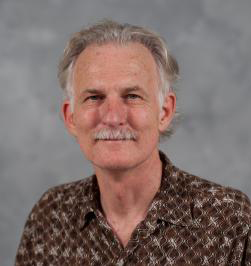
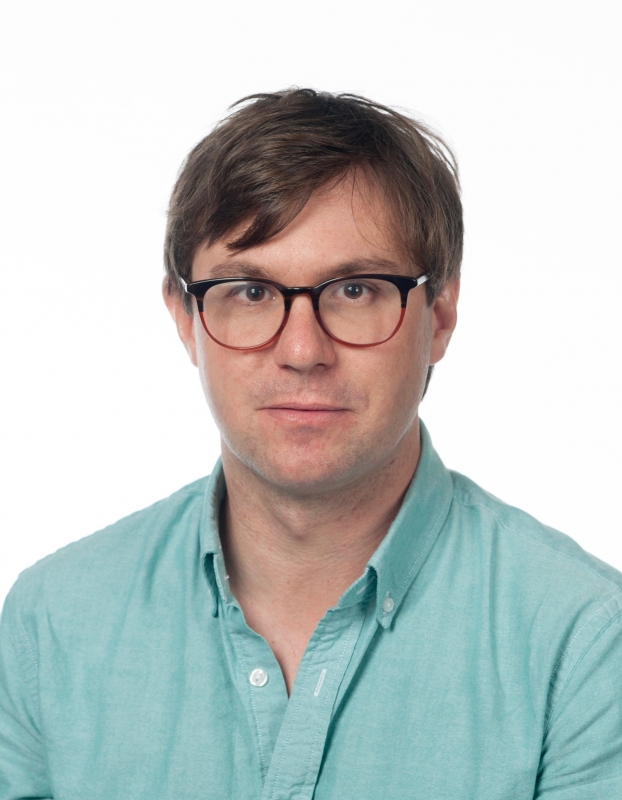
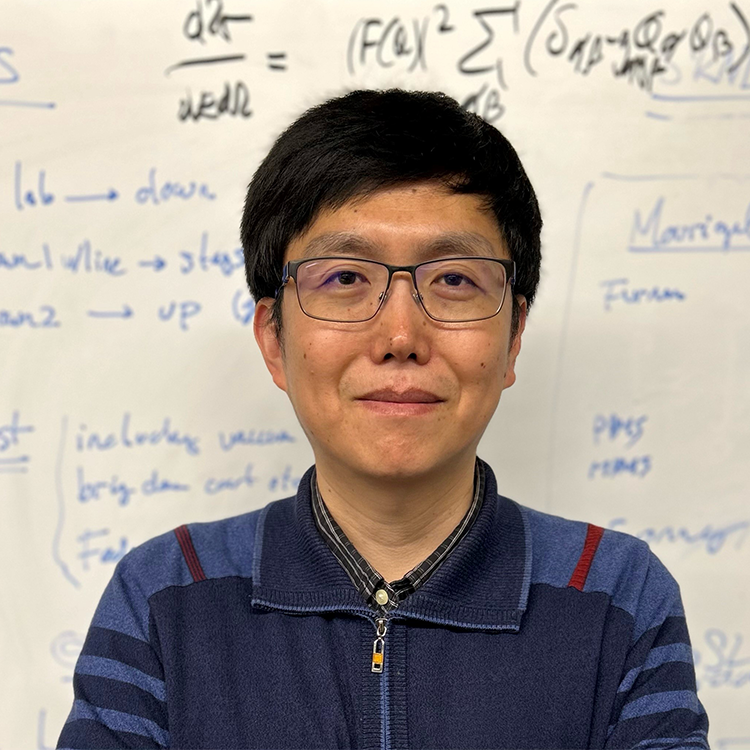
Harold Kim

Harold Kim's profile picture
harold.kim@physics.gatech.edu
Professor
Phone
404-894-0080
Office
Boggs B-83
Additional Research

I am interested in understanding (i) how transcription factors find their targets on DNA and activate transcription despite the presence of nucleosomes and (ii) how structural details of trans-activators and cis-elements quantitatively fine-tune gene regulation at the cellular level. The Harold Kim Lab is an experimental biophysics group studying the biophysics of the genome in the School of Physics atGeorgia Institute ofTechnology.A meter-long DNA is tightly packaged into chromosomes inside a micron-wide nucleus of a cell. Therefore, the genetic information is difficult to locate and process. Despite this formidable challenge, cells constantly convert the genetic code into appropriate amounts of proteins in a timely manner based on external signals. This interesting phenomenon is at the core of our research.

University, College, and School/Department
Google Scholar
https://scholar.google.com/citations?user=pbKLBNsAAAAJ&hl=en&oi=ao

Daniel Goldman

Daniel Goldman's profile picture
dgoldman3@gatech.edu

My research integrates my work in complex fluids and granular media and the biomechanics of locomotion of organisms and robots to address problems in nonequilibrium systems that involve interaction of matter with complex media. For example, how do organisms like lizards, crabs, and cockroaches cope with locomotion on complex terrestrial substrates (e.g. sand, bark, leaves, and grass). I seek to discover how biological locomotion on challenging terrain results from the nonlinear, many degree of freedom interaction of the musculoskeletal and nervous systems of organisms with materials with complex physical behavior. The study of novel biological and physical interactions with complex media can lead to the discovery of principles that govern the physics of the media. My approach is to integrate laboratory and field studies of organism biomechanics with systematic laboratory studies of physics of the substrates, as well as to create mathematical and physical (robot) models of both organism and substrate. Discovery of the principles of locomotion on such materials will enhance robot agility on such substrates

Dunn Family Professor; School of Physics
Director; Complex Rheology And Biomechanics (CRAB) Lab
Phone
404.894.0993
Office
Howey C202
Additional Research

biomechanics; neuromechanics; granular media; robotics; robophysics

University, College, and School/Department
Google Scholar
https://scholar.google.com/citations?hl=en&user=r7wE4M4AAAAJ&view_op=list_works&sortby=pubdate

Claire Berger

Claire Berger's profile picture
cb299@gatech.edu

Claire Berger is Director of Research at the French National Center for Scientific Research - Néel Institute working at the Georgia Institute of Technology in W. A. de Heer’s group. She obtained a Ph.D. in Physics from the University of Grenoble, France, with a dissertation on the electronic properties of AlMn quasicrystals. She then moved to a postdoc position at the Centre d’Etudes Atomiques, where she produced and studied amorphous films, and was hired as a researcher at the CNRS ‘s Laboratory for Study of Electronic Properties of Solids (LEPES), in Grenoble. She focused the first part of her carrier on electronic properties of quasicrystalline materials grown and characterized at LEPES. She contributed to the experimental evidence for a metal-insulator transition in these metal- based compounds. 

At Georgia Tech, her current scientific interests are primarily nanoscience and electronic property of graphene-based systems. She co-authored the first article demonstrating the two dimensional properties of graphene and proposing graphene for electronics, and together with Walt de Heer and Phil First she co-authored the first patent for graphene electronics (2003). 

She is co-author of more than 200 publications in international journals, has a citation index of 10,880 and an H index of 41.

Professor of the Practice, School of Physics
Phone
(404) 385-1685
Office
Howey N107
University, College, and School/Department

Rick Trebino

Rick Trebino's profile picture
rick.trebino@physics.gatech.edu

Education

B.A. in Physics from Harvard University 1977

M.S. in Applied Physics from Stanford University 1979

Ph.D. in Applied Physics from Stanford University 1983

Honors & Awards

2013: Fellow of the Society of Photo-Instrumentation Engineers

2010: Finalist in the Bertholdt Leibinger Prize competition for the most innovative optics invention

2010: Prism Award for the best optics invention of 2009 for the BOA pulse compressor

2009: Optical Society of America’s top optics developments of 2009 for measurements of superluminal Bessel pulses

2008: Awarded Fellow of the American Association for the Advancement of Science

2006: Fellow of the American Physical Society

2005: Circle of Excellence Award for the invention of a short-pulse GRENOUILLE

2003: R&D 100 Award for one of the top 100 technical inventions of the year for the invention of GRENOUILLE (A highly simplified ultrashort pulse measurement device)

2003: Best Optics Paper of the Year (Optical Society of America)

2000-2002 LEOS Distinguished Lecture

1999 Edgerton Prize of the SPIE

1995 Sandia National Laboratories Award for Exceptional Technical Accomplishments

1999 OSA Fellow

1997 Sandia National Laboratories Award for the Invention of Efficient, Exact Achromatic Phase-Matching

1996 Sandia National Laboratories Award for the Invention of Frequencey-Resolved Optical Gatting

1995 Sandia National Laboratories Award for Exceptional Technical Accomplishments

1995 Sandia National Laboratories Citation for Meritorious Achievement

1994 Sandia National Laboratories Award for Technical Excellence and Leadership

Research

The development of more powerful devices for manipulating and measuring potentially very complex light with ultrafast variations.

 Over 200 publications; see www.frog.gatech.edu/prose.html.

Books

 Frequency-Resolved Optical Gating: The Measurement of Ultrashort Laser Pulses, Kluwer Academic Publishers, Boston, 2002

Papers

  1. ·  J. Cohen, P. Bowlan, V. Chauhan, and R. Trebino, "Measuring temporally complex ultrashort pulses using multiple-delay crossed-beam spectral interferometry," Opt. Expr., 18(7), 6583 (2010).
  2. ·  P. Bowlan, H. Valtna-Lukner, M. Lõhmus, P. Piksarv, P. Saari, and R. Trebino, "Measurement of the spatio-temporal field of ultrashort Bessel-X pulses," Opt. Lett., 34(15), 2276, (2009).
  3. ·  R. Trebino, P. Bowlan, P. Gabolde, X. Gu, S. Akturk, and M. Kimmel, "Simple devices for measuring complex pulses," Laser & Photon. Rev., 3, 314 (2009).
  4. ·  M.A. Coughlan, M. Plewicki, S.M. Weber, P. Bowlan, R. Trebino, and R.J. Levis, "Specified electric-field construction from shaped pulses: The specific method," Opt. Expr., (2009).
  5. ·  D. Lee, P. Gabolde, and R. Trebino. "Toward single-shot measurement of broadband ultrafast continuum." J. Opt. Soc. Am. B, 25, A25 (2008).
Professor, School of Physics
Phone
(404) 385-1223
Additional Research

Electronics

University, College, and School/Department

Walter de Heer

Walter de Heer's profile picture
eheer@physics.gatech.edu

Walter Alexander “Walt” de Heer is a Dutch physicist and nanoscience researcher known for discoveries in the electronic shell structure of metal clusters, magnetism in transition metal clusters, field emission and ballistic conduction in carbon nanotubes, and graphene-based electronics.

De Heer earned a doctoral degree in Physics from the University of California, Berkeley in 1986 under the supervision of Walter D. Knight. He worked at the École Polytechnique Fédérale de Lausanne in Switzerland from 1987 to 1997, and is currently a Regents' Professor of Physics at the Georgia Institute of Technology. He directs the Epitaxial Graphene Laboratory in the School of Physics and leads the Epitaxial Graphene Interdisciplinary Research Group at the Georgia Tech Materials Research Science and Engineering Center.

Regents' Professor, School of Physics
Phone
(404) 894-7879
Additional Research

Electronics; Carbon Nanotubes; Epitaxial Growth; Graphene; Nanomaterials; quantum materials

University, College, and School/Department
Google Scholar
https://scholar.google.com/citations?hl=en&user=klW4cOMAAAAJ&view_op=list_works&sortby=pubdate

Martin Mourigal

Martin Mourigal's profile picture
mourigal@gatech.edu

Martin Mourigal is a Professor in the School of Physics and currently holds the Dunn Family Professorship. He received his undergraduate degree in materials science from École des Mines de Nancy in 2007 and his M.S. and Ph.D. in physics from École Polytechnique Fédérale de Lausanne in 2008 and 2011, respectively. He was a postdoctoral fellow at Johns Hopkins University from 2011 to 2014 and joined Georgia Tech in 2015. 

Mourigal is a condensed matter physicist specializing in quantum magnetism and neutron scattering. His group combines materials synthesis, neutron spectroscopy, and theoretical modeling to investigate exotic magnetic phases, including quantum spin liquids and multipolar states. Mourigal and his group regularly conduct experiments at U.S. Department of Energy national user facilities and other major neutron facilities in the United States and abroad. He also advances and advocates for neutron-scattering science. He has contributed to community reports on quantum materials, high magnetic fields, next-generation instrumentation, and the future of neutron scattering, and currently serves in the chair line of the American Physical Society’s Topical Group on Magnetism. 

His honors include a 2018 National Science Foundation CAREER Award, a 2019 Kavli Fellowship by the U.S. National Academy of Sciences, and the 2022 Science Prize from the Neutron Scattering Society of America. 

Mourigal also contributes to Georgia Tech’s quantum research ecosystem through interdisciplinary initiatives connecting quantum materials, quantum sensing, quantum information science, and applications of quantum technologies. He supports university-wide efforts that bring together researchers across physics, engineering, computing, chemistry, and materials science.

Dunn Family Professor, School of Physics
Phone
404.385.5669
Office
Howey C202
Additional Research
  • Quantum Materials
  • Micro and Nanomechanics
  • Ferroelectronic Materials
  • Materials Data Sciences
  • Electronics
University, College, and School/Department
Google Scholar
https://scholar.google.com/citations?hl=en&user=utYY3jYAAAAJ&view_op=list_works&sortby=pubdate

Zhigang Jiang

Zhigang Jiang's profile picture
zhigang.jiang@physics.gatech.edu

Zhigang Jiang received his B.S. in physics in 1999 from Beijing University and his Ph.D. in 2005 from Northwestern University. He was also a postdoctoral research associate at Columbia University jointly with Princeton University and NHMFL from 2005 till 2008. Jiang is interested in the quantum transport and infrared optical properties of low dimensional condensed matter systems. The current ongoing projects include: (1) infrared spectroscopy study of graphene and topological insulators, (2) spin transport in graphene devices, and (3) Andreev reflection spectroscopy of candidate topological superconductors.

Professor, School of Physics
Phone
404.385.3906
Office
Boggs B-18
Additional Research

quantum materials; nanoelectronics; Graphene; Epitaxial Growth

University, College, and School/Department
Google Scholar
https://scholar.google.com/citations?hl=en&user=6MNSoU8AAAAJ&view_op=list_works&sortby=pubdate

Dimitrios Psaltis

Dimitrios Psaltis's profile picture
dpsaltis3@gatech.edu

I am a professor of Physics at Georgia Tech. I use advanced computational techniques, hybrid computer architectures, and innovative algorithms to answer fundamental questions related to the observational appearance of black holes, the properties of magnetohydrodynamic turbulence, and the interaction of matter with radiation in extreme conditions.

I am a founding member of the Event Horizon Telescope, the international mm-VLBI experiment that has taken the first picture of a black hole with the horizon-scale resolution, and served for three years (2016-2019) as the Project Scientist of the collaboration.

Before moving to Georgia Tech in 2022, I was a professor of Physics and Astronomy at the University of Arizona and the Chair of the Theoretical Astrophysics Program there.

Professor
Additional Research
  • Black Hole Images 
  • General Relativity
University, College, and School/Department