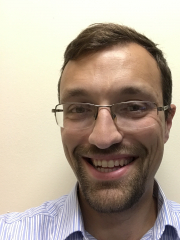
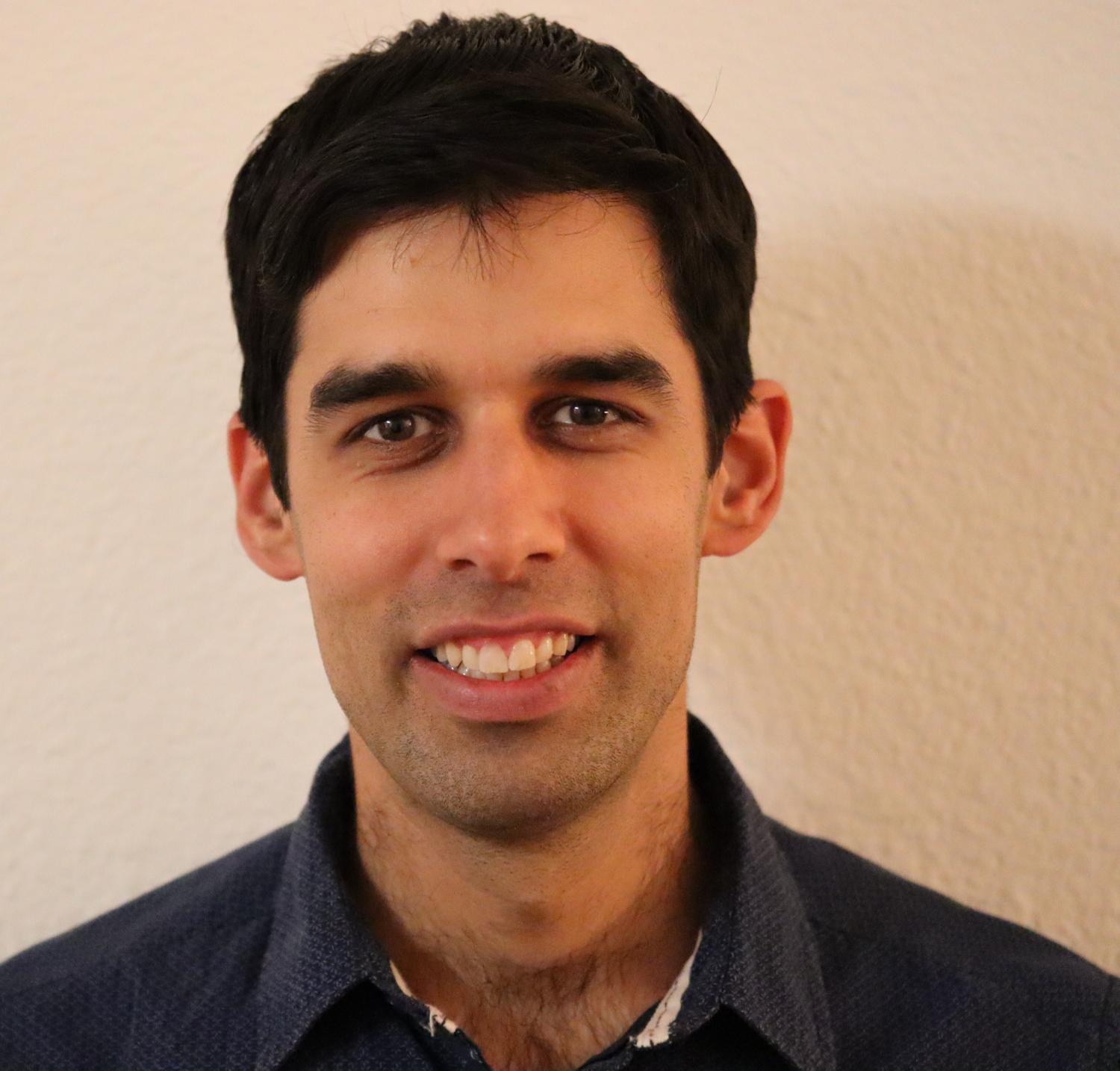
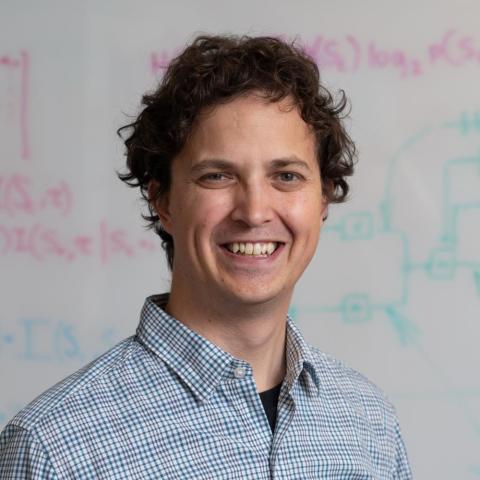
Flavio Fenton

Flavio Fenton's profile picture
flavio.fenton@physics.gatech.edu

My work is on excitable media, complex systems, and pattern formation, using a combined approach of theory, experiments, and computer simulations.

Interested in: Complex Systems, Experimental physiology, Biophysics, High performance computing and GPU.

Professor
Phone
516-672-6003
Office
Howey N05
Additional Research
  • Bioinformatics


Research Focus Areas
University, College, and School/Department
Google Scholar
https://scholar.google.com/citations?user=jKiNd-0AAAAJ&hl=en

D. Zeb Rocklin

D. Zeb Rocklin's profile picture
zeb.rocklin@physics.gatech.edu

I have a broad range of interests in soft condensed matter physics and adjacent fields like statistical physics, physics of living systems and hard condensed matter. My particular focus is on the relationship between the geometric structure of a system and its mechanical response. Both biological and engineered systems often have some structure, such as networks of struts, particles jammed together or patterns of creases in thin sheets, that grant them flexibility and strength with a minimum of weight. These structures can lead to subtle and surprising mechanical response:

Assistant Professor, School of Physics
IMS Initiative Lead, Mechanical Metamaterials
Phone
404.385.8104
Additional Research

Condensed matter physics, statistical physics, physics of living systems, and hard condensed matter.

University, College, and School/Department

Chandra Raman

Chandra Raman's profile picture
craman@gatech.edu

The Raman Group has two main thrusts.  The team utilizes sophisticated tools to cool atoms to temperatures less than one millionth of a degree above absolute zero. Using these tools, they explore topics ranging from superfluidity in Bose-Einstein condensates (BECs) to quantum antiferromagnetism in a spinor condensate.  In another effort the team partners with engineers to build cutting edge atomic quantum sensors on-chip that can one day be mass-produced.

Professor, School of Physics
Phone
404.894.9062
Office
Howey N04
Additional Research

Spinor Bose-Einstein Condensates

University, College, and School/Department
Google Scholar
https://scholar.google.com/citations?hl=en&user=mBHjtLEAAAAJ&view_op=list_works&sortby=pubdate

Andrew Zangwill

Andrew Zangwill's profile picture
andrew.zangwill@physics.gatech.edu

Professor Zangwill earned a B.S. in Physics at Carnegie-Mellon University in 1976. His 1981 Ph.D. in Physics at the University of Pennsylvania introduced the time-dependent density functional method. 

He worked at Brookhaven National Laboratory and the Polytechnic Institute of Brooklyn from 1981-1985 before taking up his present position at the Georgia Institute of Technology. 

He was named a Fellow of the American Physical Society in 1997 for theoretical studies of epitaxial crystal growth. 

He is the author of the monograph Physics at Surfaces (1988) and the graduate textbook Modern Electrodynamics (2013). In 2013, he began publishing scholarly work on the history of condensed matter physics.

Professor, School of Physics
Phone
404.894.7333
Office
Howey N102
Additional Research

ElectrodynamicsEpitaxial GrowthQuantum MaterialsIII-V Semiconductor Devices

University, College, and School/Department
Google Scholar
https://scholar.google.com/citations?hl=en&user=djlUsj8AAAAJ&view_op=list_works&sortby=pubdate

Phillip First

Placeholder for headshot
phillip.first@physics.gatech.edu

A primary goal of Professor First's research is to develop an understanding of solid-state systems at atomic length scales. The main experimental tools in this pursuit are scanning tunneling microscopy (STM) and related techniques such as ballistic electron emission microscopy (BEEM). These methods rely on the quantum-mechanical tunnel effect to obtain atomically-resolved maps of the electronic structure of surfaces, clusters, and buried layers.

Professor, School of Physics
Director, Surface, Interface, and Nanostructure Research Group
Phone
404.894.0548
Office
Howey N018/ S03
Additional Research

Electron microscopy, surfaces and interfaces, graphene, epitaxial growth

Research Focus Areas
University, College, and School/Department
Google Scholar
https://scholar.google.com/citations?hl=en&user=_KM8x1kAAAAJ&view_op=list_works&sortby=pubdate

Itamar Kolvin

Itamar Kolvin's profile picture
ikolvin@gatech.edu

Itamar Kolvin received his B.Sc. (2007) in Physics and Mathematics and his M.Sc. (2009) from the Hebrew University in Jerusalem. In 2017, he completed his Ph.D. in Physics under Prof. Jay Fineberg in the Hebrew University. He was a HFSP cross-disciplinary postdoctoral fellow in the Physics Department, University of California, Santa Barbara with Pro. Zvonimir Dogic. His research interests are in the fundamentals of soft matter out-of-equilibrium: assembly, deformation, flow and fracture. Current efforts make use of model systems that are assembled of protein machineries to investigate active and adaptive material mechanics. 

Assistant Professor, School of Physics
Office
Howey Physics Building W304
University, College, and School/Department

Sabetta Matsumoto

Sabetta Matsumoto's profile picture
sabetta@gatech.edu

Sabetta Matsumoto received her B.A., M.S. and Ph.D. from the University of Pennsylvania. She was a postdoctoral fellow at the Princeton Center for Theoretical Sciences and in the Applied Mathematics group and Harvard University. She is a professor in the School of Physics at the Georgia Institute of Technology. She uses differential geometry, knot theory, and geometric topology to understand the geometry of materials and their mechanical properties. She is passionate about using textiles, 3D printing, and virtual reality to teach geometry and topology to the public.

Associate Professor
University, College, and School/Department

Peter Yunker

Peter Yunker's profile picture
peter.yunker@gatech.edu

Dr. Yunker joined Georgia Tech’s School of Physics in 2014 after finishing his biophysics postdoc at Harvard University & New England Biolabs in 2014. Before that, he earned his Ph.D. in Physics from the University of Pennsylvania in 2012 after earning a B.S. in Physics from Texas A&M University in 2005. He has won the Burstein Prize and the Denenstein Award both from UPenn along with the Eric R. Immel Memorial award for Excellence in Teaching at GT. 

Peter’s interests are biophysics, soft matter, and golden retrievers.

Associate Professor
Phone
404-385-8642
Office
Boggs B20
Additional Research
Nonequilibrium systems, densely packed active matter with life and death events, microbial physics, structural mechanics, fracture mechanics, evolution.
University, College, and School/Department
Google Scholar
https://scholar.google.com/citations?user=va75ptIAAAAJ&hl=en

James Gumbart

James Gumbart's profile picture
gumbart@physics.gatech.edu

My lab is focused on understanding how proteins and other biological systems function at a molecular level. To probe these systems, we carry out molecular dynamics simulations, modeling biological behavior one atom at a time. The simulations serve as a "computational microscope" that permits glimpses into a cell's inner workings through the application of advanced software and high-powered supercomputers. We are particularly interested in how bacteria utilize unique pathways to synthesize proteins and insert them into both the inner and outer membranes, how they import nutrients across two membranes, and how their cell walls provide shape and mechanical strength.

Associate Professor
Phone
404-385-0797
Office
Howey W202
Additional Research

Computational Chemistry

Research Focus Areas
University, College, and School/Department
Google Scholar
https://scholar.google.com/citations?user=DOMzcTgAAAAJ&hl=en

Simon Sponberg

Simon Sponberg Headshot
simon.sponberg@physics.gatech.edu

During his graduate work at UC, Berkeley, Simon sought to uncover general principles of animal locomotion that reveal control strategies underlying the remarkable stability and maneuverability of movement in nature. His work has demonstrated the importance animals’ natural dynamics for maintaining stability in the absence of neural feedback. His research emphasizes the importance of placing neural control in the appropriate dynamical context using mathematical and physical models. He has collaborated with researchers at four other institutions to transfer these principles to the design of the next generation of bio-inspired legged robots. 

Simon received his Ph.D. in Integrative Biology at UC, Berkeley and has been a Hertz Fellow since 2002. His work has led to fellowships and awards from the National Science Foundation, the University of California, the Woods Hole Marine Biological Institute, the American Physical Society, the Society of Integrative and Comparative Biology, and the International Association of Physics Students. He is also currently affiliated the new Center for Interdisciplinary Bio-Inspiration in Education and Research (CIBER) at Berkeley.

Glen Robinson Professor in Complex Systems, Schools of Physics and Biological Sciences
Director, Agile Systems Lab
Phone
404.385.4053
Office
Howey C205
Additional Research

A central challenge for many organisms is the generation of stable, versatile locomotion through irregular, complex environments. Animals have evolved to negotiate almost every environment on this planet. To do this, animals'nervous systems acquire, process and act upon information. Yet their brains must operate through the mechanics of the body's sensors and actuators to both perceive and act upon the environment. Ourresearch investigates howphysics and physiologyenable locomoting animals to achieve the remarkable stability and maneuverability we see in biological systems. Conceptually, this demands combining neuroscience, muscle physiology, and biomechanics with an eye towards revealing mechanism and principle -- an integrative science of biological movement. This emerging field, termedneuromechanics, does for biology what mechatronics, the integration of electrical and mechanical system design, has done for engineering. Namely, it provides a mechanistic context for the electrical (neuro-) and physical (mechanical) determinants of movement in organisms. Weexplore how animals fly and run stably even in the face of repeated perturbations, how the multifuncationality of muscles arises from their physiological properties, and how the tiny brains of insects organize and execute movement.

Research Focus Areas
University, College, and School/Department
Google Scholar
https://scholar.google.com/citations?user=kKFx7RgAAAAJ&hl=en