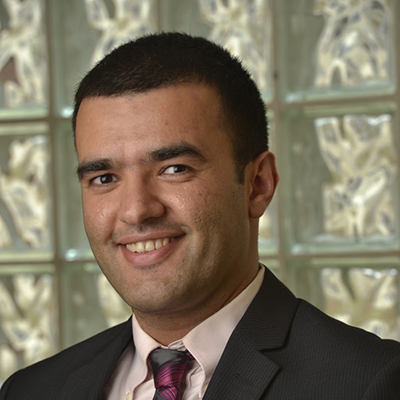
Sukarno Mertoguno

Sukarno Mertoguno
karno@gatech.edu

I am a Research Professor in the School of Cybersecurity and Privacy at the Georgia Institute of Technology and the principal investigator of the CSAFA lab. My research interests include hardware-assisted cyber security, cyber-attack-resilient systems, and fundamental Artificial Intelligence/Machine Learning concepts.

Research Professor

Glen Chou

Glen Chou's profile picture
chou@gatech.edu

Glen Chou joined Georgia Tech as an assistant professor with a joint appointment in the School of Cybersecurity & Privacy and the School of Aerospace Engineering in November 2024. He directs the Trustworthy Robotics Lab, which designs principled algorithms that can enable general-purpose robots and autonomous systems to operate capably, safely, and securely, while remaining resilient to real-world failures and uncertainty. To achieve this, his research leverages control theory and machine learning, while connecting to optimization, computer vision, formal methods, planning, human-robot interaction, and statistics. Glen is interested in broad applications of autonomy, including robotic manipulation, vision-based navigation, aerospace, and large-scale cyber-physical systems more generally.

Glen is from Northern California. He holds dual B.S. degrees in EECS and ME from UC Berkeley, as well as an M.S. and Ph.D. in ECE from the University of Michigan. Prior to joining Georgia Tech, Glen was a postdoc at MIT CSAIL.

Assistant Professor
Office
CODA E0962B
Additional Research
  • Control theory 
  • Formal methods
  • Human Robot Interaction
  • Machine learning
  • Optimization
  • Perception-based control
IRI And Role
Google Scholar
https://scholar.google.com/citations?hl=en&user=90whi3wAAAAJ&view_op=list_works&sortby=pubdate

Saman Zonouz

Saman Zonouz's profile picture
szonouz6@gatech.edu

Saman Zonouz is an Associate Professor in the School of Cybersecurity and Privacy and the School of Electrical and Computer Engineering at Georgia Tech, where he directs the Cyber-Physical Security Lab (CPSec) and the Cyber-Physical Systems track of Georgia Tech's Online Master of Science in Cybersecurity. His research develops the theory and tools needed to build provably dependable and secure cyber-physical systems, spanning formal verification and reverse engineering of embedded control firmware, physics-aware attack detection and forensics, and real-time intrusion response that draws on both systems security and control theory. His group applies this work to robotic and autonomous platforms, including unmanned aerial vehicles, robotic ground vehicles, and in-vehicle networks, as well as to additive manufacturing, industrial controllers, and power-grid infrastructure. A complementary line of work on trustworthy and efficient AI includes learning-based robot motion planning and robust, compressed deep neural networks for embedded and edge deployment. He teaches courses such as “Cybersecurity of Drones” (Cybersecurity of Autonomous Vehicles), and Introduction to Cyber-Physical Systems Security. 

Zonouz's research has been supported by NSF, DOE, DOW, DHS, ONR, ARPA-E, ARPA-H, and industry partners. He is a recipient of the Presidential Early Career Award for Scientists and Engineers (PECASE), the NSF CAREER Award in Cyber-Physical Systems, the NSA Significant Research in Cyber Security award, the Air Force Office of Scientific Research Faculty Fellowship, and a Google Security Hall of Fame award; his work has also received a Distinguished Paper Award at ACM CCS 2024 and the Outstanding Mid-Career Faculty Research Award from Georgia Tech's College of Computing. He received his Ph.D. in Computer Science from the University of Illinois at Urbana-Champaign and his B.Sc. in Computer Engineering from Sharif University of Technology, where he also competed internationally in RoboCup robot soccer, and won world Championship in Rescue League in Japan, Osaka 2005.

Associate Professor, School of Cybersecurity and Privacy, School of Electrical and Computer Engineering
Director, Georgia Tech’s Online Master of Science in Cybersecurity - Cyber-Physical Systems Track
Office
Coda E0964B
Additional Research
  • Cyber-physical systems security and resilience
  • Security of unmanned aerial vehicles, robotic vehicles, and autonomous systems
  • Embedded control firmware analysis: reverse engineering, formal verification, and physics-based attestation
  • Physics-aware intrusion detection and response for robots and industrial controllers
  • Automotive and in-vehicle network (CAN) security
  • Secure and trustworthy additive and AI-driven manufacturing
Google Scholar
https://scholar.google.com/citations?hl=en&user=kgFnNewAAAAJ&view_op=list_works&sortby=pubdate