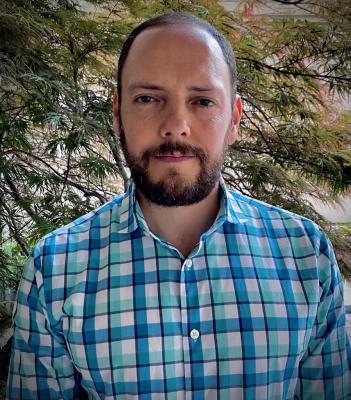
Germán Vergara (Ph.D., University of California, Berkeley) specializes in environmental and Latin American history. His research and teaching explore environmental change, animal history, energy regimes, and the ecological problems of capitalism(s) and industrialization in Latin America, which he tries hard to locate in a global context.
His first book, Fueling Mexico: Energy and Environment, 1850-1950 (Cambridge University Press, 2021), examined how and why modern Mexico transitioned from an agrarian society powered by animal muscle, water, and wood to a fossil-fueled industrial society. Within a century, Mexico went from an energy regime based on dispersed solar energy accumulated in plants and human and animal muscle to one based on the concentrated ancient sunlight trapped in fossil fuels. The book argues that the shift to a carbon-based society has been the main agent of environmental, economic, and social change in Mexico for over a century. The decision to power the country’s economy with fossil fuels locked Mexico in a cycle of endless, fossil-fueled growth. Fueling Mexico is the first study to look at the historical roots of today's global fossil-fuel energy regime from a Latin American perspective. The book was the recipient of the 2021-2023 Elinor Melville Prize for Latin American Environmental History (Conference on Latin American History-CLAH) and received an honorable mention for Best Book in the Humanities 2022 from the Latin American Studies Association (LASA).
Germán's second book project focuses on the biodiversity and extinction crisis in the Americas. Recent estimates suggest that 41 percent of described amphibians, 26 percent of mammals, and 13 percent of birds currently face the threat of extinction worldwide. One of the global centers of biodiversity, the Americas are at the heart of the current extinction crisis. Few regions of the world have experienced as many extinctions or near extinctions as the Western Hemisphere. The book will examine the historical roots of this crisis, adopting a very long-term perspective to better understand the social, cultural, and economic patterns that have resulted in high rates of species loss. Somewhat unwisely, the book will travel from the Late Pleistocene to the modern history of capitalism in the region to ponder whether humans are a uniquely adept species at extinguishing other life forms. Less abstractly, the book will discuss topics such as the recent capitalist commodification of animals and nature, scientific ideas about extinction, animal-human relations, and conservation efforts in the Americas over the centuries.
Germán has published on energy, forest history, animal history, species extinctions, and has a forthcoming chapter on the environmental history of mining in Mexico. His article "How Coal Kept My Valley Green: Forest Conservation, State Intervention, and the Transition to Fossil Fuels in Mexico" was published in Environmental History. "Animals in Latin American History" appeared in the Oxford Encyclopedia of Latin American History. He co-edited and co-authored the Forum "Extinction and Its Interventions in the Americas" for Environmental History in 2022.
After earning his Ph.D. from the University of California, Berkeley, Germán spent two years as a postdoctoral fellow in environmental history at Brown University. He has received fellowships from the University of California Institute for Mexico and the United States (UC MEXUS), the Charles A. Hale Fellowship for Mexican History from the Latin American Studies Association, and the USMEX Fellowship Program at the University of California, San Diego. He was selected as the 2022-23 Cisneros Visiting Scholar of the David Rockefeller Center for Latin American Studies (DRCLAS) at Harvard University.
Education:
- Ph.D. in History, University of California, Berkeley
Areas of
Expertise:
- Agriculture
- Animal History
- Cities
- Energy History
- Environmental History
- Food
- Industrialization
- Latin America
- Mexico
Additional Research
Agriculture, Health, and the Environment Energy, Climate and Environmental Policy Global Cities and Urban Society History of Technology/Engineering and Society Modern Global History/Science, Technology, and Nationalism