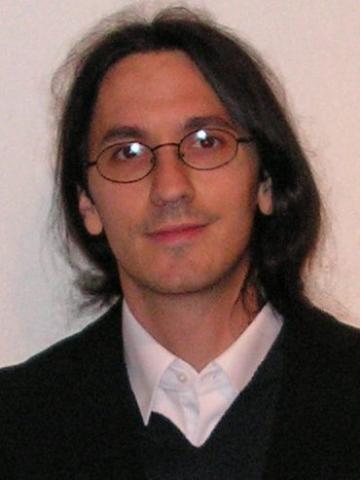
Charles Pippin

Charles Pippin's profile picture
charles.pippin@gtri.gatech.edu

Charles Pippin is a Senior Research Scientist at the Georgia Tech Research Institute, GTRI. His research interests include collaborative autonomy algorithms, machine learning, and multi-robot systems. In his current work, he is investigating cooperation between autonomous systems, as part of GTRI's Unmanned Systems Initiative. Charles received a Ph.D. in Computer Science from Georgia Tech in 2013. His research advisor was Prof. Henrik I. Christensen. Charles received an M.S. in Computer Science from Georgia Tech in 2004 and holds a B.S. in Computer Science from the University of Alabama in Huntsville.

Senior Research Scientist; Georgia Tech Research Institute
Office
GTRI
Additional Research

collaborative autonomy algorithms; machine learning; and multi-robot systems

Research Focus Areas
IRI And Role
GTRI
Geogia Tech Research Institute > Aerospace, Transportation & Advanced Systems Laboratory

Sang-Won Leigh

Sang-Won Leigh's profile picture
sang.leigh@design.gatech.edu

Sang's research and art practice focuses on robotic and computational tools that work together with human users. His vision proposes extreme synergies between machine tools and humans, with technology essentially becoming a natural extension of our hands. This way, he challenges the fear and criticism around AI and automation that they replace human endeavors, by showing how symbiotic machines can unlock new human explorations and aesthetics. The impact of his research spans from publications in top tier HCI conferences such as CHI, TEI, and NIME, journals including Leonardo and IEEE Pervasive Computing, to design awards and art exhibitions. Several of his work were awarded the Fast Company Innovation by Design Award, and have been shown in art exhibitions at SIGGRAPH ASIA, CHI, TEI, and more. His work A Flying Pantograph was included in the Otherly Space / Knowledge exhibition at the Asia Culture Center along with some of the most prominent new media artists today. In 2014, He was an artist-in-residence at Microsoft Research Studio 99 where he created Remnance of Form - an interactive light and shadow installation. His work has received extensive media coverage from BBC, WIRED, Discovery, Fast Company and so on, and he was invited to national and international events including Sebasi+Pan, TEDx events, Seoul Digital Forum, and more. He is starting at Georgia Tech Industrial Design as an assistant professor. He has helped Artmatr in the development of a machine painting technology and its creative use through collaboration with some of today's most prominent painters. He received his Ph.D. from MIT Media Lab in 2018. Prior to that, he was a software engineer at Samsung Electronics where he led the software development of eyeCan, an open-source DIY eye-mouse designed for people with motor disability. This project became the foundation of Samsung's C-LAB. He received his Bachelor and Master of Science from KAIST, focusing on 3D Computer Vision and Machine Learning.

Assistant Professor; School of Industrial Design
Phone
N/A
Additional Research
  • HCI
  • Media Arts
Research Focus Areas
IRI And Role
University, College, and School/Department
Google Scholar
https://scholar.google.com/citations?hl=en&user=5PS-lv8AAAAJ&view_op=list_works&sortby=pubdate

Matthew T. Flavin

Matthew T. Flavin; ECE
mflavin@gatech.edu

Prof. Matthew Flavin is an assistant professor in the School of Electrical and Computer Engineering at the Georgia Institute of Technology where he leads the Flavin Neuromachines Lab. Before joining the faculty at Georgia Tech, he was a postdoctoral researcher at Northwestern University. He received his M.S. and Ph.D. degrees in Electrical Engineering in 2017 and 2021 from the Massachusetts Institute of Technology (MIT), and he received his B.S. in Electrical Engineering in 2015 from the University of Illinois at Urbana-Champaign (UIUC). He received the NIH Ruth L. Kirschstein Institutional National Research Service Award (T32) and the Draper Laboratory Fellowship. The vision for his independent research program is to develop powerful peripheral neural interfaces and mechatronic wearables that leverage advanced sensors and intelligent systems to address important and unresolved challenges in patient care.

Assistant Professor
Office
Van Leer 325A
Additional Research
  • Bioengineering
  • Biotechnology
  • Communications
  • Computer Engineering
  • Cyber Technology
  • Cyber-Physical Systems
  • Drug Design, Development and Delivery
  • Electronic Materials
  • Energy Harvesting
  • Flexible Electronics
  • Healthcare
  • Human Augmentation
  • Human-Centered Robotics
  • IoT for Manufacturing
  • IoT/Machine-to-Machine Trust
  • Lifelong Health and Well-Being
  • Locomotion & Manipulation
  • Machine Learning
  • Medical Device Design, Development and Delivery
  • Micro and Nano Device Engineering
  • Miniaturization & Integration
  • Mobile & Wireless Communications
  • Neuroscience
  • Precision Machining
  • Regenerative Medicine
  • Robotics
  • Soft Robotics
Google Scholar
https://scholar.google.com/citations?user=3VgPQZoAAAAJ

Anirban Mazumdar

Anirban Mazumdar's profile picture
anirban.mazumdar@me.gatech.edu

Dr. Anirban Mazumdar joined Georgia Tech as an Assistant Professor in Mechanical Engineering in 2018. Dr. Mazumdar studies robot mobility with the goal of understanding and achieving agile, versatile, and efficient robot behaviors in unstructured environments. His previous experience includes a postdoctoral research position in the High Consequence Automation and Robotics Group at Sandia National Laboratories in Albuquerque, NM. He has broad experience with novel robotic systems including energy efficient bipedal robots, reconfigurable aerial vehicles, prosthetic devices, and relaxed stability mobile robots.

Assistant Professor; School of Mechanical Engineering
Director; Dynamic Adaptive Robotic Technologies (DART) Lab
Phone
404.385.8061
Office
Callaway Building 432
Additional Research

Mobile Robots; Human Performance; Autonomy

Research Focus Areas
Google Scholar
https://scholar.google.com/citations?hl=en&user=cRHSdPYAAAAJ&view_op=list_works&sortby=pubdate

Rusty Roberts

Rusty  Roberts's profile picture
rusty.roberts@gtri.gatech.edu

Rusty Roberts is the Director of the Aerospace, Transportation and Advanced Systems (ATAS) Laboratory at the Georgia Tech Research Institute (GTRI). ATAS develops advanced systems concepts, builds system prototypes, and performs research on technologies related to aerospace, transportation, power and energy, threat systems, and food processing. A nationally recognized expert in test and evaluation, Roberts has held the position of the President of the International Test and Evaluation Association (ITEA). He also started and presently leads a GTRI-wide test and evaluation initiative that brought together the resources to provide Science & Technology support to the Office of the Secretary of Defense Test Resource Management Center. Mr. Roberts has also worked with U.S. government officials to establish key requirements for the testing of U.S. electronic countermeasures against surface-to-air missile threats and has been able to provide solutions developed by GTRI. Solutions included the threat replica of a medium range surface-to-air missile (SAM) acquisition radar for the U.S. Army and the Advanced Airborne Interceptor Simulator (AAIS) for the U.S. Air Force. He also led the efforts that developed the Missle-on-a-Mountain program at the Electronic Combat Range in China Lake, California. This one-of-a-kind simulation facility has been called a key national asset in testing electronic countermeasures against surface-to-air missle systems. The facility is in high demand by the U.S. Navy, U.S. Air Force, and allied air forces. Prior to joining GTRI, Mr. Roberts served as an active duty U.S. Army Signal Corps officer for ten years, with assignments at Fort Gordon, GA and Kaiserslautern, Germany. His last assignment was at the U.S. Military Academy at West Point as an Assistant Professor in the Department of Electrical Engineering teaching Electronic Circuit Design. During his tour at West Point he became the Course Director for the Senior-level, two-semester electronics course for the Department. Mr. Roberts continued to serve in the Army Reserve after leaving Active Duty while at GTRI. Roberts holds a Bachelor of Science degree in Electrical Engineering from West Point, a Master of Science degree in Electrical Engineering from the Georgia Institute of Technology, and a Master of Business Administration degree in Finance from Long Island University.

Director, Aerospace, Transportation and Advanced Systems (ATAS) Laboratory, Georgia Tech Research Institute
Phone
404.407.7826
Additional Research

Autonomy; Transportation; Smart Infrastructure

Research Focus Areas
GTRI
Geogia Tech Research Institute

Jonnalagadda V R Prasad

Jonnalagadda V R Prasad's profile picture
jvr.prasad@aerospace.gatech.edu

Dr. J.V.R. Prasad is a professor in the School of Daniel Guggenheim School of Aerospace Engineering at the Georgia Institute of Technology working in the area of flight mechanics and control. He received his B.Tech degree from the Indian Institute of Technology, Madras, India and his M.S and Ph.D. degrees from the Georgia Institute of Technology, Atlanta, USA. He is currently a co-principal investigator and the associate director for the US Army, Navy and NASA sponsored Vertical Lift Rotorcraft Center of Excellence (VLRCOE) program at Georgia Tech. He has extensive research and design experience in rotorcraft system modeling and control, propulsion system modeling and control, and autonomous air vehicle modeling and control. He published parts of four books, sixty refereed journal papers, more than 250 conference papers and 80 research project reports. He has 18 invention disclosures and five patents to his credit. He is a recipient of the 2009 Melville Medal award from the American Society of Mechanical Engineers (ASME) and the 2015 Aero Lion Technologies Outstanding Journal Paper award from the International Journal of Unmanned Systems. He served as the editor-in-chief of the Journal of the American Helicopter Society (AHS), chair of the Handling Qualities and UAV Tech Committees of the AHS, and as member and secretary of the Atmospheric. Flight Mechanics Technical Committee of the American Institute of Aeronautics and Astronautics (AIAA). He currently serves as a member of the editorial board for the International Journal on Mathematical Modeling and Simulation and the advisory board for the International Journal of Unmanned Systems. He is a Fellow of the AIAA, a Technical Fellow of the AHS and a member of the ASME.

Professor; School of Aerospace Engineering
Associate Director; Vertical Lift Research Center of Excellence
Phone
404.894.3043
Office
Knight 421A
Additional Research

Flight Mechanics & Controls

Research Focus Areas
IRI And Role