Jack Weeks

jsweeks@gatech.edu
Research Engineer I
IRI And Role
University, College, and School/Department


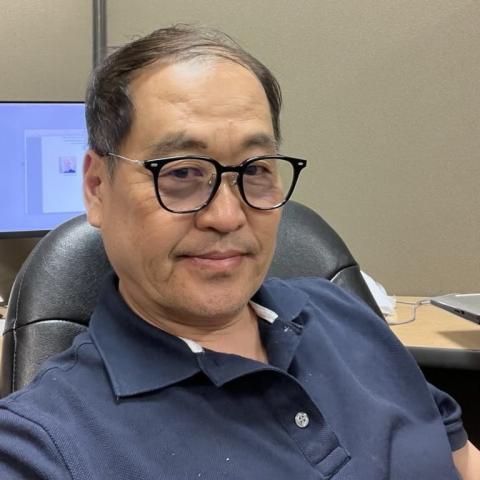
Biography
Dr. Kim’s research interest is broadly described as applied mathematics applications to modeling and experimental characterization of material behaviors. His current research focuses on the development of measurement techniques and mathematical models for the quantitative nondestructive evaluation (NDE) of nuclear, aerospace, and civil engineering materials. He has over 20 years of experience in the ultrasonic NDE and related research areas including ultrasonic wave propagation, micromechanics, and fatigue fracture analysis. His past research in aerospace material NDE, attracting more than $3 million research projects, has addressed the most important NDE issues in the safety of aging aircraft structure and the remaining life-time prediction. Dr. Kim has authored and co-authored over 140 technical papers and book chapters in these areas. His research has been supported by FAA, DARPA, DOE, USAF, NASA, FHWA, NSF, Corning Co., etc. Dr. Kim earned his PhD and MS degrees in Mechanical Engineering from Korea Advanced Institute of Science and Technology (KAIST).


Maegan Lenertz is a Research Engineer at the Georgia Tech Manufacturing Institute with a background in Mechanical Engineering and Robotics. Maegan received her bachelor's in mechanical engineering from Embry-Riddle Aeronautical University in Prescott, Arizona. Her research interests lie in robotics, hybrid and additive manufacturing, system programming, automation, and mechatronic design.

Saleeby was formerly a research staff member from Oak Ridge National Laboratory where he was in the Manufacturing Science Division. His work focuses on connecting machines and manufacturing processes with Industry 4.0 and Industrial IoT technologies. Current interests center on applications of data analytics and closed-loop control for Hybrid Manufacturing processes, where additive and subtractive (machining) processes are combined within a single machine tool.

Dr. Kan Wang is a research faculty in the Georgia Tech Manufacturing Institute at Georgia Institute of Technology. Dr. Wang's current research focus inerests include tissue engineering, bioprintinng, biosensors, and supply chain of regenerative medicine. He has conducted over 15 research projects sponsored by major federal agencies including National Science Foundation, Food and Drug Administration, Department of Defense and Department of Veterans Affairs. Dr. Wang has published 4 book chapters, over 50 peer-reviewed journal articles and 5 patents.

Andrew Dugenske is the Director of the Factory Information Systems (FIS) Center and a Principal Research Engineer at the Georgia Tech Manufacturing Institute (GTMI). He is also founder and C.E.O. of Factory Right LLC, a software company that provides information technology solutions to manufacturing enterprises and was co-founder and president of Great Technological Collaborations Inc. In addition, Mr. Dugenske is a State of Georgia registered professional engineer.
For the past 20 years, Mr. Dugenske has led dozens of industry-funded projects relating to software systems and supply chain issues across a variety of industries. He currently acts as an industry liaison for Georgia Tech, conducts short courses, publishes, and consults in the area of Factory Information Systems (FIS). He is a member of the National Electronics Manufacturing Initiative (NEMI) FIS working and implementation groups, the NEMI road mapping team, several IPC technical committees, the JISSO International Council and the joint NEMI-IPC CAMX standardization committees. Prior to his arrival at GTMI, Mr. Dugenske was a Research Engineer at the Georgia Tech Research Institute (GTRI), where he developed computer-controlled radar positioning systems, conducted structural analysis using finite element analysis, and provided design expertise. He received a B.S. from the University of Illinois, an M.S. from the Georgia Institute of Technology both in Mechanical Engineering.

Zach Brunson is a Research Engineer in the G. W. Woodruff School of Mechanical Engineering at the Georgia Institute of Technology, working primarily at the Advanced Manufacturing Pilot Facility (AMPF). Prior to Georgia Tech, Zach was a graduate teaching fellow and research assistant at the Colorado School of Mines in Golden Colorado where he received his Ph.D. (2021) and M.S. (2019) in Mechanical Engineering studying theoretical and experimental mechanics of inelastic anisotropic and asymmetric materials. Prior to pursuing a graduate degree, Zach gained experience working as a measurements field engineer in the petroleum industry (2013-2015) after earning his B.S. (2013) in Mechanical Engineering from the University of Colorado in Boulder Colorado.
Zach’s research revolves around as manufactured material property prediction, measurement, and certification. The two major thrusts of his research are: (1) theoretical and experimental mechanics of inelastic anisotropic and asymmetric materials and (2) sensor development for process monitoring and part qualification in directed energy deposition (DED) additive manufacturing (AM) systems. By developing a more complete understanding of the elastic limits of anisotropic and asymmetric materials, we can better describe both the deformation during manufacturing processes such as forging, forming, or rolling and the final strength of as manufactured (conventionally or AM) components. By developing sensor systems to monitor AM processes such as DED, we can begin to better inform the creation of predictive models, identify critical events related to part performance, improve feedback controls for more reliability and repeatability, and ultimately qualify processes and certify components.