
Introduction to "The IPaT Way" - A People-Centered Approach to Providing Technical Solutions
Pictured clockwise from upper left: Michael Best, Maribeth Coleman, Clint Zeagler, and Noah Posner.
Please RSVP if attending >>
Introduction to "The IPaT Way" - A People-Centered Approach to Providing Technical Solutions
Georgia Tech Recognizes Excellence with 2026 Institute Research Awards
Mar 25, 2026 — Atlanta
Georgia Tech has announced the 2026 Institute Research Award recipients, recognizing faculty and staff whose work has made significant scientific, technological, and societal impact.
Presented by the Office of the Executive Vice President for Research, the awards honor contributions across the full research spectrum — from fundamental discovery to technology commercialization.
Winners were selected across six award categories highlighting innovation, mentorship, collaboration, and community engagement, including two awards presented to teams for their collective achievements.
“The strength of Georgia Tech’s research enterprise begins with the talented people who push discovery forward every day,” said Tim Lieuwen, executive vice president for Research. “Congratulations to this year’s honorees, who demonstrate what it means to turn bold ideas into real-world impact, advancing knowledge from fundamental science to commercial and community applications. With these awards, we celebrate their leadership, creativity, and dedication to serving the public good.”
Considered among Georgia Tech’s most prestigious internal honors, the awards rely on a peer‑driven nomination process that emphasizes measurable contributions and leadership across disciplines. Recipients include both early‑career researchers making emerging breakthroughs and long‑standing faculty and staff recognized for sustained excellence and mentorship.
Awardees will be celebrated at the Georgia Tech Faculty and Staff Honors Luncheon on April 24 in the Midtown Ballroom Exhibition Hall.
2026 Institute Research Award Winners
Outstanding Achievement in Research Engagement and Outreach — Edward Botchwey
Awarded to a faculty member who demonstrates excellence in research engagement and outreach to other institutions of Higher Education or external partners.
Outstanding Achievement in Research Enterprise Enhancement — Anna Österholm
Awarded to a member of the administrative staff whose exceptional contributions advance the research and scholarly enterprise and exemplify the values of the Institute Focus Areas and/or Big Bets.
Outstanding Achievement in Research Innovation — Lakshmi ‘Prasad’ Dasi
Recognizes a faculty member who excels in research engagement and outreach through meaningful collaboration with higher education institutions and/or external partners, advancing awareness, scholarship, and understanding of research topics and the broader research process, with demonstrated impact on audiences and scholarly work.
Outstanding Doctoral Thesis Advisor — Shimeng Yu
Recognizes a faculty member whose excellence in doctoral advising is reflected in the achievements of their doctoral students who completed all degree requirements between January 1, 2021, and December 31, 2025. This award honors exceptional mentorship demonstrated through advising approach, guidance practices, and meaningful student outcomes.
Outstanding Achievement in Research Program Development — Human Space Exploration Team
Recognizes a faculty‑ and staff‑led research team that has developed a thought‑leadership platform to significantly expand Georgia Tech’s research and scholarship portfolio through impactful engagement, collaboration, and outreach that advances understanding of research and scholarly topics and processes.
Outstanding Achievement in Research Program Impact — Georgia Artificial Intelligence in Manufacturing (GA-AIM)
Recognizes a faculty‑ and staff‑led research team whose innovative program has significantly expanded Georgia Tech’s research portfolio, demonstrating measurable impact, broad influence, and meaningful engagement with external partners across academic, industry, and community sectors.
Shelley Wunder-Smith
Research Communications
Yuanzhi Tang Named Executive Director of the Strategic Energy Institute
Feb 02, 2026 —

Yuanzhi Tang
Georgia Tech has appointed Yuanzhi Tang as executive director of the Strategic Energy Institute (SEI), effective Feb. 1.
Tang will lead the strategic vision, interdisciplinary research efforts, and internal and external partnerships at SEI, strengthening connections across Georgia Tech’s Colleges, Interdisciplinary Research Institutes (IRI), the Georgia Tech Research Institute (GTRI), and external partners to advance energy-related initiatives.
Founded in 2004, SEI is one of Georgia Tech’s IRIs and serves as a campuswide hub for energy research, education, and engagement.
Tang is the Georgia Power Professor in the School of Earth and Atmospheric Sciences. Her research and leadership focus on advancing secure, circular, and sustainable energy systems by integrating Earth, environmental, biological, materials, and sustainability sciences and innovations. She previously served as an initiative lead on sustainable resources at SEI as well as the associate director for interdisciplinary research at the Brook Byers Institute for Sustainable Systems.
“Professor Tang brings a strong record of research impact, leadership of complex initiatives, and a collaborative approach that will help elevate Georgia Tech’s energy research enterprise,” said Julia Kubanek, vice president for Interdisciplinary Research at Georgia Tech. “She brings deep expertise in fundamental Earth and environmental science, including water, soil, and energy research, while also leading state and regional partnerships in emerging, applied areas such as critical minerals. Most importantly, she is community-minded with excellent listening and consensus-building skills.”
As executive director, Tang will develop and communicate a unifying vision to advance interdisciplinary energy research and strategic thought leadership at Georgia Tech, integrating expertise across engineering, sciences, computing, business, design, economics, policy, and the humanities.
Tang is also the founding director of the Center for Critical Mineral Solutions and leads a multidisciplinary coalition spanning three University System of Georgia institutions. The coalition connects research, industry, and policy to build Georgia’s critical minerals innovation ecosystem, while driving resource advancement, workforce development, and economic impact.
“I'm honored to serve as the executive director of SEI. Georgia Tech’s energy research and the people behind it have always inspired me. I’m eager to listen, learn, and work alongside our community,” said Tang. “SEI connects research excellence with real-world impact, and I look forward to partnering across campus, industry, government, and communities to translate breakthrough ideas into solutions that strengthen energy security, reliability, and affordability.”
About the Strategic Energy Institute
The Strategic Energy Institute (SEI) serves as a system integrator for more than 1,000 Georgia Tech researchers working across the entire energy value chain. SEI brings together expertise to address complex energy challenges, from commercializing scalable technologies to informing long-term energy strategy and policy. Through research, education, community building, resource development, and thought leadership, SEI mobilizes Georgia Tech’s collective strengths to advance reliable, affordable, and lower-carbon energy solutions for a growing global demand.
Priya Devarajan || Communications Program Manager
Strategic Energy Institute
Conversations@TechSquare: Beyond Pilots: Innovations, Institutions, and Impact in a Post-Aid World
Drawing on experience across international NGOs, government partnerships, UN agencies, philanthropy, and technology-enabled innovation, this session will explore why so many promising ideas struggle to survive once donor funding ends. Rather than focusing on tools alone, we’ll examine the institutional, governance, and market conditions that determine whether innovation endures—or quietly disappears.
Confronting the Roadblocks in Medical Technology Innovation
Jan 29, 2026 —
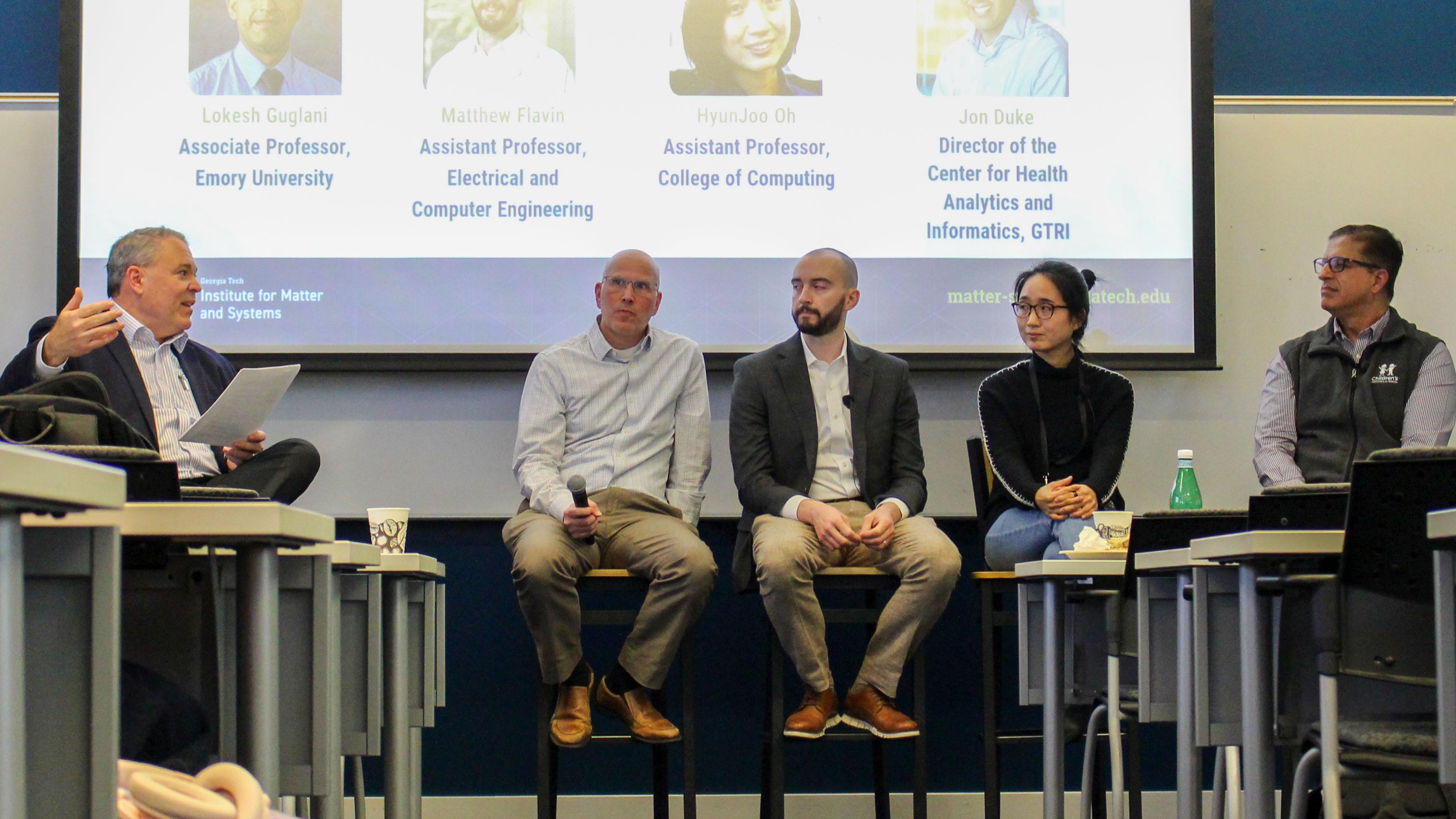
Georgia Tech’s Institute for Matter and Systems (IMS) hosted its second Boundaries and Breakthroughs panel on Jan. 27, bringing together leading clinicians, engineers, and data experts to examine why promising medical technologies often fail to translate into clinical practice.
Moderated by IMS Executive Director Eric Vogel, the panel explored how innovation, regulation, economics and clinical realities intersect to shape the future of medical devices.
The panel featured John Duke, physician and director of the Center for Health Analytics and Informatics at Georgia Tech Research Institute; Matthew Flavin, assistant professor in the School of Electrical and Computer Engineering; HyunJoo Oh, assistant professor in the schools of Industrial Design and Interactive Computing; and Lokesh Guglani, pediatric pulmonologist and clinician-researcher at Children’s Healthcare of Atlanta.
Vogel opened the event by highlighting the gap between technological novelty and real-world medical adoption.
“About 75% of medical device start-ups never achieve commercial success or make it to market, and some industry estimates push this higher,” Vogel said. “Even those that reach the market often fail to gain meaningful adoption. This may be because technologists optimize for platforms five or 10 years out and are rewarded by novelty, whereas clinicians demand reliability, interpretability, and outcomes that hold up with real patients, real workflows, and real liability.”
Throughout the discussion, panelists examined the tension between rapid innovation and clinical safety, noting that the level of invasiveness often determines how bold developers can be.
“We must remember that in medicine—and especially when we're dealing with human lives—there's a significant asymmetry of the harm that could be done,” said Guglani. “Even a small change or an oversight at the design level of a medical device can have significant downstream repercussions for patients and create liability for institutions and providers.”
Flavin and Duke added that excessive conservatism, particularly around non-invasive wearable, can also slow potentially life-changing advancements.
All panelists agreed that breakthrough technology alone is not enough to ensure clinical adoption. Usability, workflow fit, and time efficiency often determine whether clinicians adopt a device. Tools that require lengthy calibration or add to a clinician’s already tight schedule rarely succeed. Even when a technology integrates well, reimbursement barriers can prevent adoption.
“A lot of technologies come out, but then if the clinic is using them and is not being reimbursed for the time spent, that creates a bottleneck,” said Guglani.
Economic constraints also shape who benefits from innovation. Children with rare diseases, stroke survivors, and other small or heterogeneous patient groups often struggle to attract investors, even when their needs are urgent.
The panelists also discussed the dual role of regulatory and manufacturing standards. Good Manufacturing Practice (GMP) requirements ensures consistent, safe production, but force teams to lock designs earlier than ideal, adding cost and slowing iteration. These requirements protect patients but also function as an economic filter for many early-stage technologies.
The conversation then turned to data, AI, and the education of future innovators. Despite massive amounts of health data, many clinically important areas remain data‑scarce. Wearable devices, such as smart watches, may help close these gaps, but AI models remain limited by the quality of input data.
When asked about preparing the next generation of MedTech innovators, panelists emphasized the importance of “interface literacy” or the ability to collaborate across disciplinary boundaries and understand how design decisions cascade into real clinical environments.
“You really do have to be able to be interdisciplinary,” said Duke. “Now of course what makes things go is not often the knowledge of the domain, but the person’s role or connectivity into the system.”
Vogel closed by emphasizing that successful medical technology development requires “ongoing, honest collaboration” across fields. The Boundaries and Breakthroughs series will continue that mission in February with a panel on the future of the electric grid.
Amelia Neumeister | Communications Program Manager
The Institute for Matter and Systems
Research as the Practice of Freedom
SPEAKER: Stacy Branham, Associate Professor of Informatics at the University of California, Irvine
Georgia Insurance Claims Database Provides Health Care Cost Comparisons
Jan 21, 2026 —

Georgia residents now have a new way to compare the estimated costs paid for a large variety of health care services in the state, thanks to a resource created by the Georgia All-Payer Claims Database. (iStock photo)
Georgia residents now have a new way to compare the estimated costs paid for a large variety of health care services in the state, thanks to a searchable “shop for care” resource launched as part of the Georgia All-Payer Claims Database (GA APCD).
The Georgia APCD Cost Comparison Tool (apcd.georgia.gov/cost-comparison-tool) contains information on more than 200 different medical procedures ranging from cardiac stress tests and childbirth to knee replacement and colonoscopies. The resource provides information on the median cost paid for the procedures statewide, along with information on what individual medical facilities and professional providers have been paid for each type of procedure.
For each procedure, the tool identifies medical facility providers nearest to the consumer and includes facility ratings collected by the Centers for Medicare & Medicaid Services (CMS). For each facility providing a specific service, the comparison data includes the median cost for the procedure and the range of costs that were paid. Costs can be filtered by payer category, including commercial, Medicare, and Medicaid. While that data is understandably incomplete and includes caveats, developers of the new service say it provides a much-needed resource for Georgians facing a decision on a costly medical procedure.
“In health care, there are a lot of factors that can drive cost and it’s not always a straightforward equation, so it’s worth doing the research,” said Dr. Jon Duke, an M.D. and principal research scientist in the Georgia Tech Research Institute’s (GTRI) Health Emerging and Advanced Technologies Division, which administers the APCD for the state of Georgia. “This is really just one part of health care decision-making, and it will help patients be more proactive advocates for themselves when considering potential options for care.”
Dr. Duke is also a faculty member in Georgia Tech's Institute for People and Technology. You can read the full article published by the Georgia Tech Research Institute here.
Computational Ecosystems: Advancing Human Values Through Integrative Computing and Changing Practice
SPEAKER: Haoqi Zhang, Associate Professor in Computer Science and Design at Northwestern University
Accompaniment in Human-Centered Design: From Digital Interventions to Community and Dialogue
SPEAKER: Susan Wyche, Associate Professor, Department of Media and Information, Michigan State University
Everyday Data and AI Practices: A Novel Approach to Studying Workplace Computing
SPEAKER: Betsy DiSalvo, Professor in the School of Interactive Computing at Georgia Tech