
Newly Named Children’s PTC at Georgia Tech Peterson Professorship Recipients Work to Improve the Lives of Kids in Georgia and Beyond
Apr 18, 2025 — Atlanta
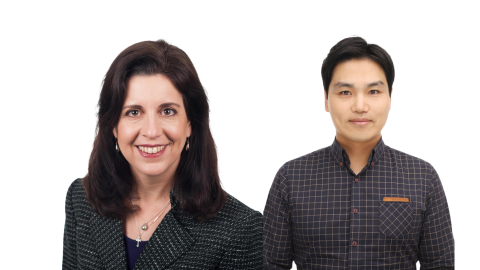
Michelle LaPlaca (left), associate chair for Faculty Development and professor in the Department of Biomedical Engineering; W. Hong Yeo, Harris Saunders, Jr. Professor in the George W. Woodruff School of Mechanical Engineering.
Georgia Tech professors Michelle LaPlaca and W. Hong Yeo have been selected as recipients of Peterson Professorships with the Children’s Healthcare of Atlanta Pediatric Technology Center (PTC) at Georgia Tech. The professorships, supported by the G.P. “Bud” Peterson and Valerie H. Peterson Faculty Endowment Fund, are meant to further energize the Georgia Tech and Children’s partnership by engaging and empowering researchers involved in pediatrics.
In a joint statement, PTC co-directors Wilbur Lam and Stanislav Emelianov said, “The appointment of Dr. LaPlaca and Dr. Yeo as Peterson Professors exemplifies the vision of Bud and Valerie Peterson — advancing innovation and collaboration through the Pediatric Technology Center to bring breakthrough ideas from the lab to the bedside, improving the lives of children and transforming healthcare.”
LaPlaca is a professor and associate chair for Faculty Development in the Department of Biomedical Engineering, a joint department between Georgia Tech and Emory University. Her research is focused on traumatic brain injury and concussion, concentrating on sources of heterogeneity and clinical translation. Specifically, she is working on biomarker discovery, the role of the glymphatic system, and novel virtual reality neurological assessments.
“I am thrilled to be chosen as one of the Peterson Professors and appreciate Bud and Valerie Peterson’s dedication to pediatric research,” she said. “The professorship will allow me to broaden research in pediatric concussion assessment and college student concussion awareness, as well as to identify biomarkers in experimental models of brain injury.”
In addition to the research lab, LaPlaca will work with an undergraduate research class called Concussion Connect, which is part of the Vertically Integrated Projects program at Georgia Tech.
“Through the PTC, Georgia Tech and Children’s will positively impact brain health in Georgia’s pediatric population,” said LaPlaca.
Yeo is the Harris Saunders, Jr. Professor in the George W. Woodruff School of Mechanical Engineering and the director of the Wearable Intelligent Systems and Healthcare Center at Georgia Tech. His research focuses on nanomanufacturing and membrane electronics to develop soft biomedical devices aimed at improving disease diagnostics, therapeutics, and rehabilitation.
“I am truly honored to be awarded the Peterson Professorship from the Children’s PTC at Georgia Tech,” he said. “This recognition will greatly enhance my research efforts in developing soft bioelectronics aimed at advancing pediatric healthcare, as well as expand education opportunities for the next generation of undergraduate and graduate students interested in creating innovative medical devices that align seamlessly with the recent NSF Research Traineeship grant I received. I am eager to contribute to the dynamic partnership between Georgia Tech and Children’s Healthcare of Atlanta and to empower innovative solutions that will improve the lives of children.”
The Peterson Professorships honor the former Georgia Tech President and First Lady, whose vision for the importance of research in improving pediatric healthcare has had an enormous positive impact on the care of pediatric patients in our state and region.
The Children’s PTC at Georgia Tech brings clinical experts from Children’s together with Georgia Tech scientists and engineers to develop technological solutions to problems in the health and care of children. Children’s PTC provides extraordinary opportunities for interdisciplinary collaboration in pediatrics, creating breakthrough discoveries that often can only be found at the intersection of multiple disciplines. These collaborations also allow us to bring discoveries to the clinic and the bedside, thereby enhancing the lives of children and young adults. The mission of the PTC is to establish the world’s leading program in the development of technological solutions for children’s health, focused on three strategic areas that will have a lasting impact on Georgia’s kids and beyond.
McLaughlin Named Cooper Union President
Apr 21, 2025 — Atlanta, GA

Steven W. McLaughlin
Steven W. McLaughlin, provost and executive vice president for Academic Affairs, has been named the 14th president of The Cooper Union for the Advancement of Science and Art, effective July 1. The Cooper Union is a private college with internationally renowned schools of architecture, art, and engineering, and a faculty of humanities and social sciences.
McLaughlin has spent nearly 30 years at Georgia Tech in various roles, both in the classroom and in administration. As provost and executive vice president for Academic Affairs, a role he has held since 2020, McLaughlin provides leadership to all academic and related units, including 29 Schools and seven Colleges. As provost, he oversaw the launch of Georgia Tech’s College of Lifetime Learning in 2024. Previously, McLaughlin was the dean and Southern Company Chair of the College of Engineering, the Steve W. Chaddick School Chair in the School of Electrical and Computer Engineering, and vice provost for International Initiatives and Steven A. Denning Chair in Global Engagement.
“Steve has been an important colleague and a dear friend, and his leadership has made a lasting impact on Georgia Tech,” said President Ángel Cabrera. “He has been a steadfast advocate for academic excellence and student success, always pushing us to be better and do more. Throughout his career, Steve has led with a deep commitment to expanding access and opportunity, ensuring that more students can benefit from the life-changing impact of higher education. I can’t think of a better match than Steve and The Cooper Union — an institution that shares his deep belief in the power of education to transform lives.”
In 2014, McLaughlin co-founded CREATE-X, a campuswide effort to instill entrepreneurial confidence in students and help them launch companies. Since then, the program has successfully launched 200 student-led companies and engaged over 4,000 students. McLaughlin also oversaw the renovation and creation of the Van Leer Interdisciplinary Design Commons and Makerspace while chair of ECE.
In 2011, he was awarded the Chevalier dans l'Ordre National du Mérite (Knight of the French National Order of Merit), the second-highest civilian award given by the Republic of France. He was the first Georgia Tech recipient of the Presidential Early Career Award for Scientists and Engineers, and he is a Fellow of the IEEE and a past president of the IEEE Information Theory Society.
McLaughlin’s research interests are in communications and information theory. His research group has published more than 250 papers in journals and conferences and holds 36 U.S. patents in the areas of forward error correction and equalization in wireless communications, data security, and privacy, among others.
“As higher education continues to change at an accelerated pace, we have identified an educator and proven leader who is known for his transformative impact and high degree of emotional intelligence,” said Jamie Levitt, interim board chair and co-chair of Cooper’s presidential search committee. “Steve is a champion of students and, throughout his career, has sought to create learning experiences for students to grow as creative, ethical, globally aware, technologically sophisticated leaders who can define and solve problems to improve the human condition.”
“With all that is happening in higher education today, the vision of Peter Cooper is as relevant as ever,” McLaughlin said. “The Cooper Union is the right place at the right time, and I can’t wait to get started.”
HPC Machine Learning and Big Data Workshop
PACE in collaboration with the Pittsburgh Supercomputing Center is pleased to host an HPC workshop on Machine Learning and Big Data, to be held May 13-14, 2025.
This workshop will focus on topics including big data analytics and machine learning with Spark, and deep learning using Tensorflow. It will have a hands-on component using the Bridges-2 computing platform at the Pittsburgh Supercomputing Center.
This event will be held in person at satellite sites, including Georgia Tech.
Georgia Tech Joins Virtual Reality Augmented Reality Association
Apr 29, 2025 —

With over 50 chapters around the world, the VRARA boasts a network of more than 60,000 professionals and 4,000 organizations.
Georgia Tech is proud to announce its membership with the Virtual Reality Augmented Reality Association (VRARA) — marking a significant step in advancing innovation in the fields of augmented reality (AR) and virtual reality (VR). Founded in 2015, the VRARA is an international organization dedicated to fostering collaboration among industry leaders, promoting innovation, and advancing the adoption of immersive technologies. As a strategic sponsor of the VRARA’s Atlanta chapter, Georgia Tech plays a key role in advancing extended reality (XR) throughout the global ecosystem.
As a leading higher education institution, Georgia Tech has been at the forefront of AR and VR research and development. The Augmented Environments Lab has pioneered immersive digital experiences since 1998, focusing on applications that integrate physical environments with digital augmentation. Additionally, the Office of Information Technology (OIT) has been actively exploring XR technologies to enhance teaching, learning, and research, including partnerships with the Georgia Tech Library and its Center for 21st Century Universities, the Invention Studio @ Georgia Tech, and through efforts with faculty and student groups to explore immersive ER-based collaboration and co-design — the intersection of arts and XR.
“Joining the VRARA reflects Georgia Tech's commitment to driving innovation and supporting lifetime learners,” said Didier Contis, executive director of OIT’s Academic Research Technologies. “Our collaboration with VRARA will enable us to leverage our expertise in AR, VR, and artificial intelligence to develop innovative solutions that benefit our students, researchers, and the broader community."
Georgia Tech’s membership with the VRARA is also expected to bolster Atlanta's reputation as a hub for technological advancements and talent, aligning with the City of Atlanta’s dedication to attracting and retaining top professionals through initiatives that promote a diverse and skilled workforce. The collaboration is also poised to create new opportunities for research, development, and collaboration, further solidifying Atlanta’s position as a leader in the tech industry.
“Georgia Tech is one of the world’s premier universities,” said Adam Kornuth, president of the VRARA Atlanta chapter. “We couldn’t be more excited about our continued collaboration to drive strategic impact through innovation in the Southeast — and beyond.”
With over 50 chapters around the world, the VRARA boasts a network of more than 60,000 professionals and 4,000 organizations.
For more information about the Virtual Reality Augmented Reality Association, visit thevrara.com.
Boosting Research with LLMs Workshop
Apr 02, 2025 — Atlanta
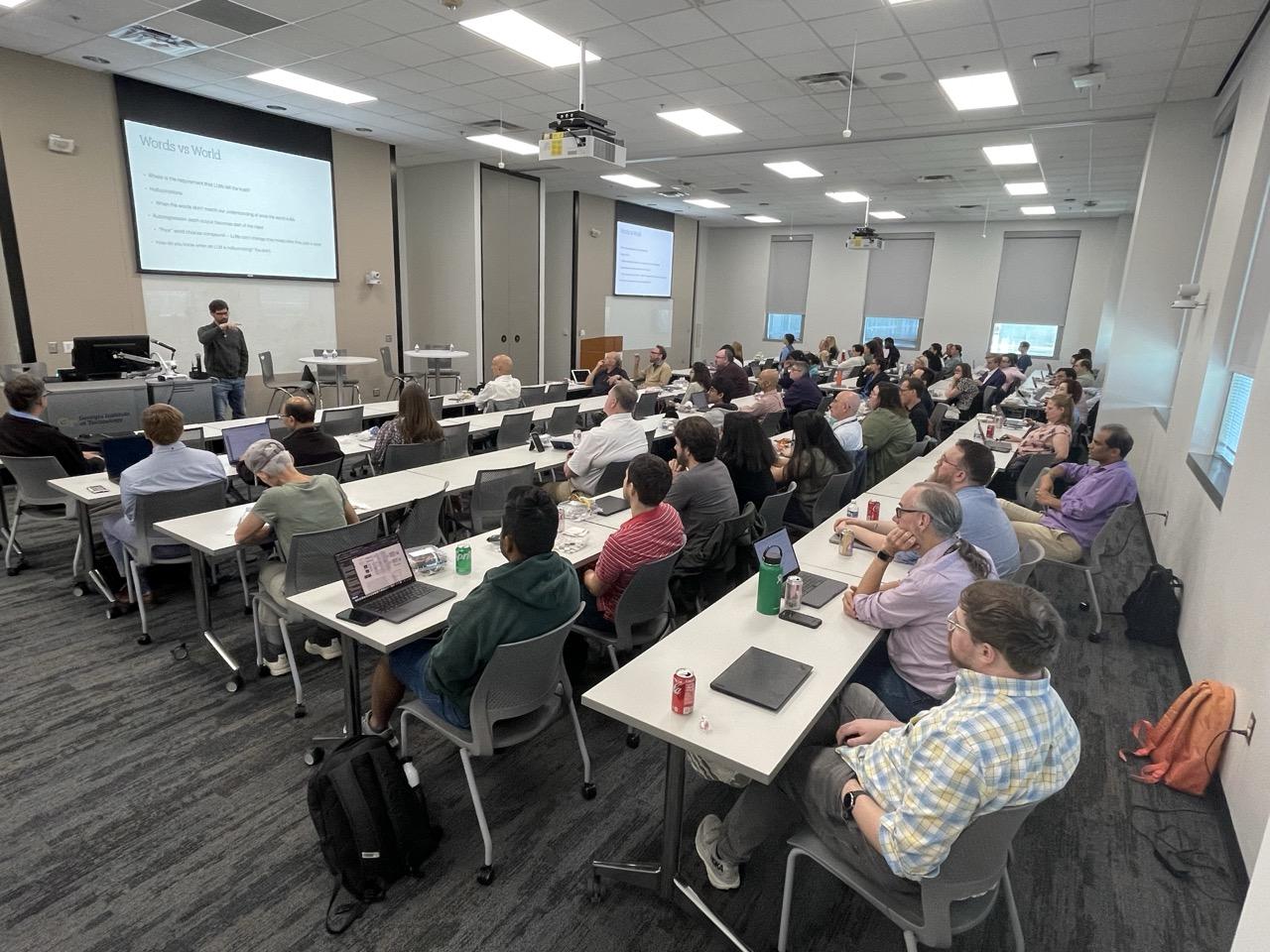
One half of the room at the Boosting Research with LLMs Workshop held April 1, 2025
More than 80 participants attended a dynamic half-day workshop exploring how large language models (LLMs) can accelerate scientific discovery across disciplines. The workshop, Boosting Research with LLMs, was held April 1 in the Technology Square Research Building’s ballroom and was co-sponsored by the Institute for People and Technology (IPaT) and the Institute for Data Engineering and Science (IDEaS).
The workshop presented three expert-led panels to uncover practical applications of LLMs for engineers, natural scientists, computer scientists, and social scientists-transforming the way they analyze data, generate insights, and advance research.
The workshop was designed for beginners and required no prior experience with LLMs, making it a unique opportunity to explore cutting-edge Al tools that can enhance research capabilities. The event was open to Georgia Tech faculty, graduate students, researchers and staff.
"The LLM workshop drew in participants with a wide range of interests,” said David Sherrill, Regents’ Professor in the School of Chemistry and Biochemistry, and interim executive director of IDEaS. “It was exciting to hear how LLMs are being used by students and faculty to accelerate their research in science, engineering, and social sciences."
View the agenda and the thirteen presenters >>
LLM Workshop event (image).
CREATE-X Demo Day 2025
Join us for CREATE-X Demo Day 2025! On August 28, meet the 12th batch of Georgia Tech Startups using the latest technology to solve big problems and launch successful ventures. Experience the newest batch of 200+ founders at Georgia Tech during CREATE-X’s 2025 Demo Day. This year, we’re debuting the 12th cohort of founders, adding 100+ startups to our over 650. Collectively, our startups have generated a total portfolio evaluation of more than $2.4B, with the last cohort already valued over $80M.
DolphinGemma: How Google AI is helping decode dolphin communication
Apr 14, 2025 — Atlanta
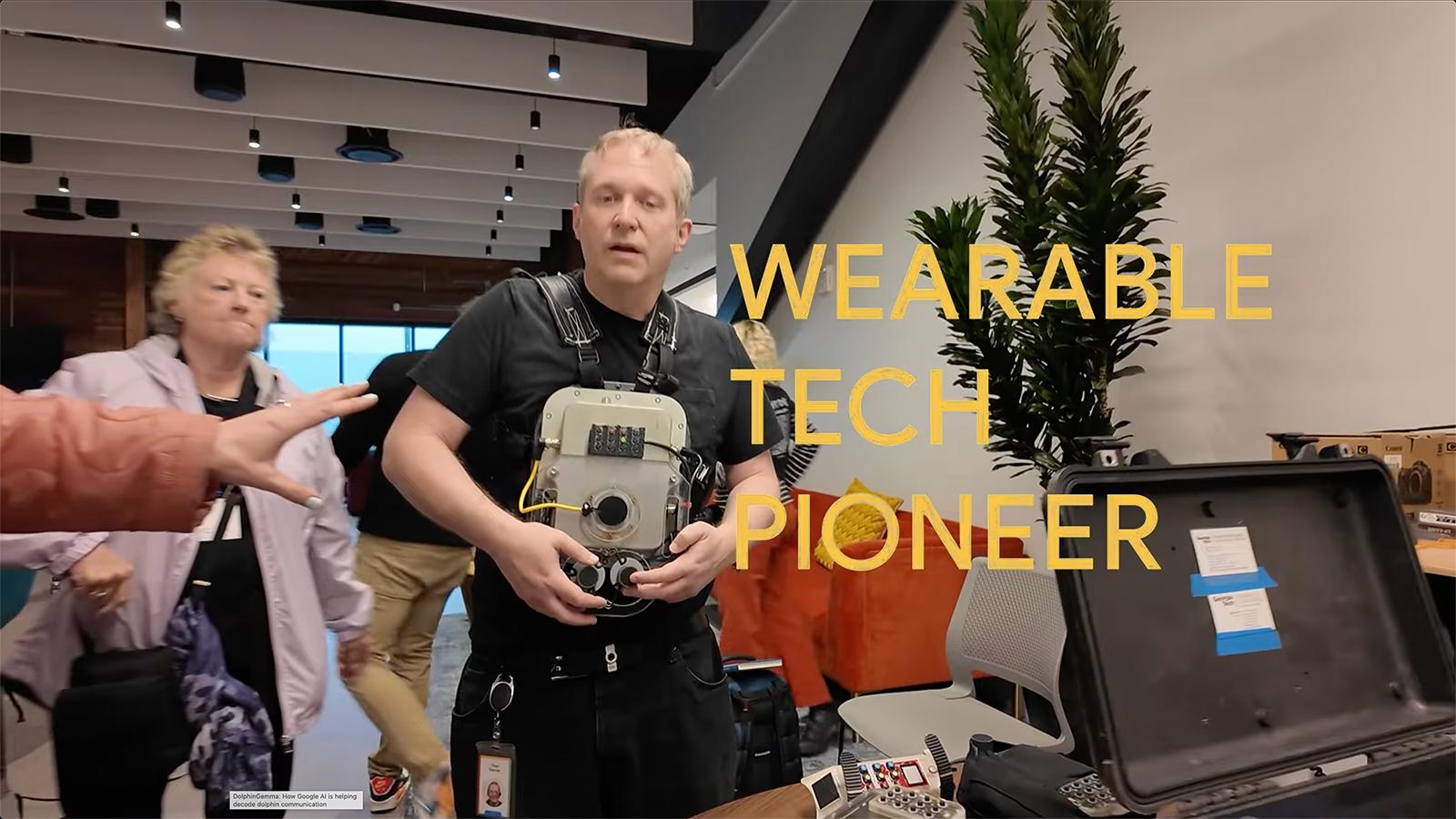
Picured: Thad Starner, Professor, School of Interactive Computing wearing a device intended to communicate with dolphins.
For decades, understanding the clicks, whistles and burst pulses of dolphins has been a scientific frontier. What if we could not only listen to dolphins, but also understand the patterns of their complex communication well enough to generate realistic responses?
Today, on National Dolphin Day, Google, in collaboration with researchers at Georgia Tech and the field research of the Wild Dolphin Project (WDP), is announcing progress on DolphinGemma: a foundational AI model trained to learn the structure of dolphin vocalizations and generate novel dolphin-like sound sequences. This approach in the quest for interspecies communication pushes the boundaries of AI and our potential connection with the marine world.
Read the full story from Google here >>
This story features three Georgia Tech researchers involved with the wild dolphin project.

New Wearable Device Monitors Skin Health in Real Time
Apr 14, 2025 —
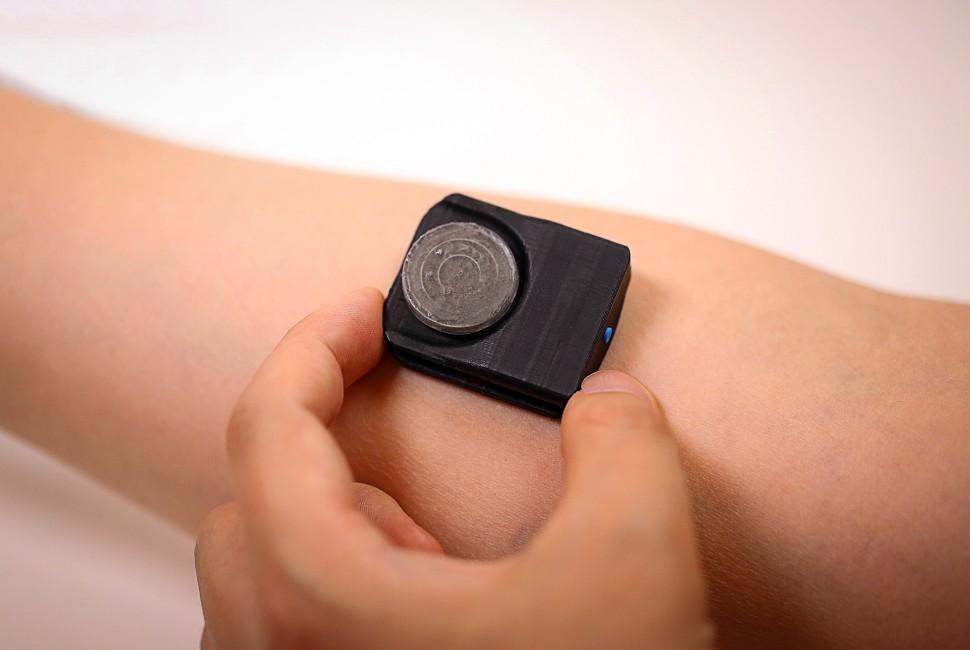
The wireless device measures only two centimeters in length and one-and-a-half centimeters in width, and is the first of its kind to continuously monitor the skin's exchange of vapors with the environment.
From sun damage and pollution to cuts and infections, our skin protects us from a lot. But it isn’t impenetrable.
“We tend to think of our skin as being this impermeable barrier that’s just enclosing our body,” said Matthew Flavin, assistant professor in the School of Electrical and Computer Engineering. “Our skin is constantly in flux with the gases that are in our environment and our atmosphere.”
Led by the Georgia Institute of Technology, Northwestern University, and the Korea Institute of Science and Technology (KIST), researchers have developed a novel wearable device that can monitor the flux of vapors through the skin, offering new insights into skin health and wound healing. This technology, detailed in a recent Nature publication, represents a significant advancement in the field of wearable bioelectronics.
“You could think of this being used where a Band-Aid is being used,” said Flavin, one of the lead authors of the study. The compact, wireless device is the first wearable technology able to continuously and precisely measure water vapor, volatile organic compounds, and carbon dioxide fluxes in the skin in real time. Because increases in these factors are associated with infection and delayed healing, Flavin notes that this kind of wireless monitoring “could give clinicians a new tool to understand the properties of the skin.”
The Measurement Barrier
Our skin is our first line of defense against environmental hazards. Measuring how effectively it protects us from harmful pollutants or infections has been a significant challenge, especially over extended periods.
“The vapors coming from your skin are in very, very low concentration,” explained Flavin. “If we just put a sensor next to your skin, it would be almost impossible to control that measurement.”
The new device features a small chamber that condenses and measures vapors from the skin using specialized sensors hovering above the skin. A low-energy, bi-stable mechanism periodically refreshes the air in the chamber, allowing for continuous measurements communicated to a smartphone or tablet through Bluetooth.
“There are other devices that can measure certain parts of what we're talking about here,” said Flavin, “but they are not feasible for a wearable device, can't do this continuously, and are not able to get all the information that our device can get.”
Scratching the Surface
By tracking the skin's water vapor flux, also known as transepidermal water loss, the device can assess skin barrier function and wound healing. This capability is particularly valuable for tracking the healing process in diabetic patients, who often have sensory issues that complicate wound monitoring. “What you see in diabetes is that even after the wound looks like it's healed, there's still a persistent impairment of that barrier,” said Flavin. This new non-invasive device tracks those properties.
“There are many areas where people don't have great access to healthcare, and there aren’t doctors monitoring wound healing processes,” Flavin added. “Something that can be used to monitor that remotely could make care more accessible to people with these conditions.”
The device’s wearable nature also makes it ideal for studying the long-term effects of exposure to environmental hazards like wildfires or chemical fumes on skin function and overall health.
Though the applications in health are numerous, the research team is continuing to explore different ways to use the device. “This measurement modality is very new and we're still learning what we can do with it,” saidJaeho Shin, a senior researcher at KIST and a co-leader of the study. “It's a new way of measuring what's inside the body.”
“This is a great example of the kind of technology that can emerge from research at the interface between engineering science and medical practice,” said John Rogers, a materials science professor at Northwestern and another co-leader of the study. “The capabilities provided by this device will not only improve patient care, but they will also lead to improved understanding of the skin, the skin microbiome, the processes of wound healing, and many others.”
As a new faculty member and a member of Georgia Tech’s Neuro Next Initiative, a burgeoning interdisciplinary research hub for neuroscience, neurotechnology, and society, Flavin attributes the success of this research to its interdisciplinary nature.
“A broad challenge we have in these fields of research is that they integrate a lot of different areas. One of the reasons I came to Georgia Tech is because it's a place where you have access to all those different areas of expertise.”
DOI: https://doi.org/10.1038/s41586-025-08825-2
Funding: Querrey-Simpson Institute for Bioelectronics and the Center for Advanced Regenerative Engineering (CARE), Northwestern University; National Research Foundation of Korea; National Institutes of Health (NIH), National Institute of Diabetes and Digestive and Kidney Diseases, National Institutes of Biomedical Imaging and Bioengineering.
Writer: Audra Davidson
Research Communications Program Manager
Neuro Next Initiative
Media contact: Angela Barajas Prendiville
Director
Institute Media Relations
2024 Foley Scholar Award Winners - Research Presentations
April 17, 2025
12:00 p.m. Lunch; 12:30 p.m. talk starts
Location: TSRB 1st Floor Ballroom, 85 Fifth St NW, Atlanta, GA 30308
2024 Foley Scholar Award Winners (MS) Momin Siddiqui and (PhDs) Vanessa Oguamanam, Charles Ramey & Jiawei Zhou to present their research.
Code Switching in the Digital World
Apr 09, 2025 — Atlanta

Technology has transformed how we communicate. Research from the Ivan Allen College of Liberal Arts shows that code-switching — the practice of switching between languages, dialects, accents, tones, or cultures in conversation — is changing with it.
Faculty members in the School of Modern Languages and the Sam Nunn School of International Affairs have published three studies examining how language and cultural code-switching have adapted to the digital age, revealing speakers’ fluency, promoting self-expression, and making messaging more effective. Their research is relevant, as the population of bilingual and bicultural people increases in the United States.
By better understanding code-switching in digital spaces, “we can reveal insights into language dynamics and cultural identity among young bilingual speakers,” says Hongchen Wu, an assistant professor in the School of Modern Languages. “Annotated code-switching datasets are also a valuable resource for training and testing language technologies tailored to bilingual speakers — allowing, for example, an AI-assistant that can understand their code-switching with no struggles.”