New Multidisciplinary Institute Marks Golden Age for Space Research
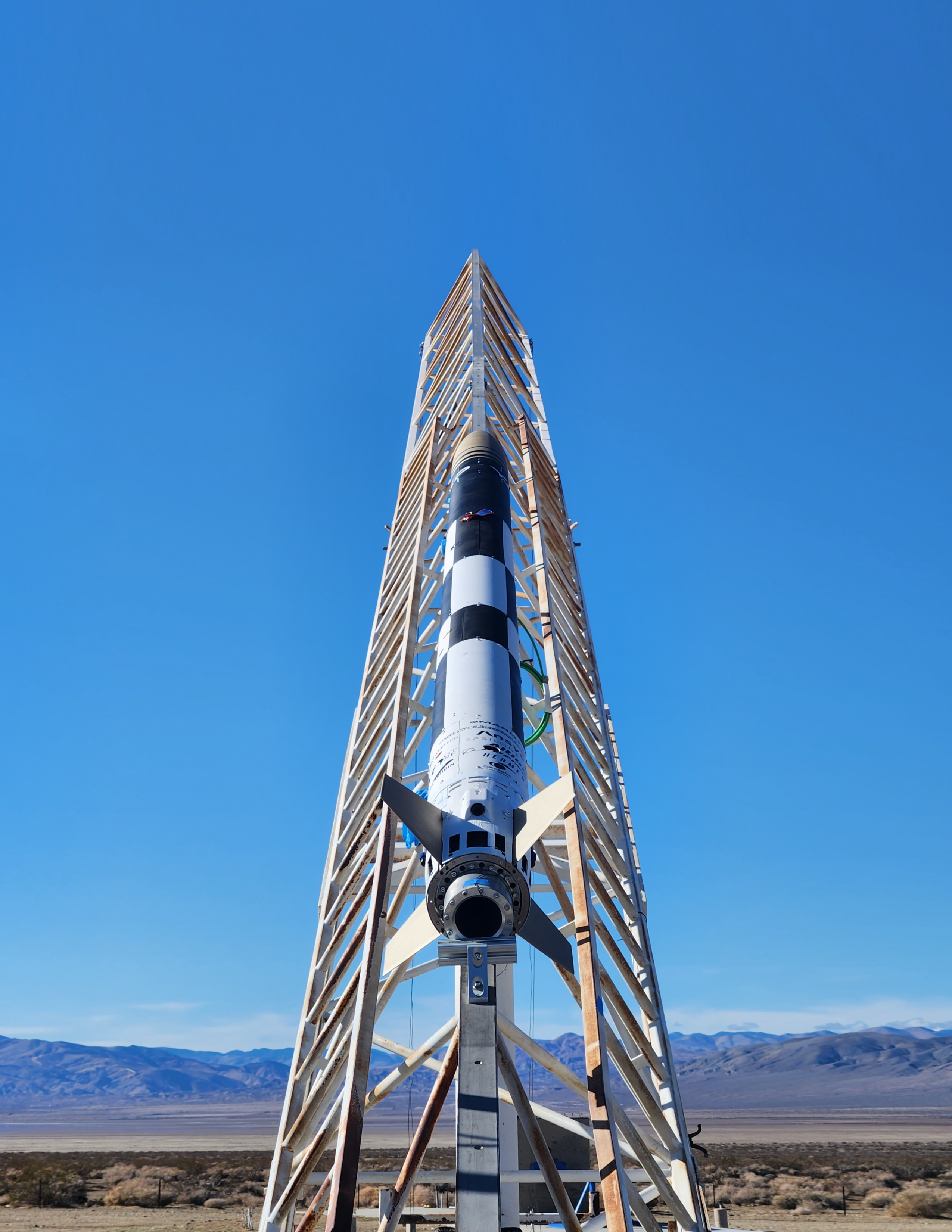
Some Georgia Tech researchers solve cosmic mysteries such as how supermassive black holes were born — and others now are getting a better, sharper look at those black holes.

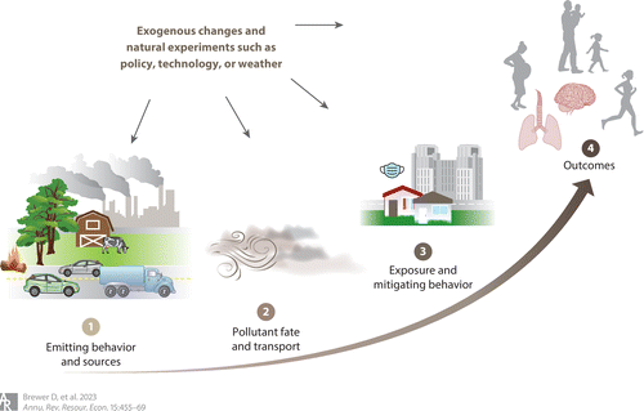
Simple schematic documenting the path of air pollution from emissions to outcomes. This review discusses the challenges of measuring how emissions of pollutants (step 1) disperse through the air (step 2) to become eventual exposures (step 3) and health outcomes (step 4).
The Energy, Policy, and Innovation Center faculty affiliates Dylan Brewer, Daniel Dench, and Interim Director Laura Taylor published an article titled "Advances in Causal Inference at the Intersection of Air Pollution and Health Outcomes." The authors compare the methods used in the epidemiology literature with the causal inference framework used in economics in analyzing the effect of air pollution on health outcomes.
Determining the quality and accuracy of the evidence linking air pollution to human health has been a challenge for research in this area.
Each academic discipline has a unique lens through which they view and solve a problem, which may result in different conclusions being drawn from the same data. While studies that involve randomization across populations can provide evidence and are widely used in medical research, exposures to everyday air pollution cannot be randomized by a researcher.
Many existing studies exploring the health impacts of air pollution rely on establishing correlations between pollutants and health outcomes. However, correlations do not imply causation and can lead to bad policy. In this study, the EPICenter affiliates reviewed methodological contributions made by economists to determine if using statistical methods to the study of the health effects of air pollution can contribute to more robust and reliable findings.
To understand the difficulty researchers face, consider a typical air pollution study that collects health data of residents living near a pollution source, such as a coal-fired power plant. The data would be used to see if there is an increased incidence of adverse health outcomes such as asthma, chronic obstructive pulmonary disease, or cardiopulmonary disease. However, many factors can create a confounding effect on the final results if the researcher doesn’t take them into consideration. For instance, the power plant may have been built in a low-income location, or lower-income households may have moved near the power plant to take advantage of lower rent or property prices. This may conflate the effect of income and air pollution on health.
Simple schematic documenting the path of air pollution from emissions to outcomes. This review discusses the challenges of measuring how emissions of pollutants (step 1) disperse through the air (step 2) to become eventual exposures (step 3) and health outcomes (step 4).
Economists promote the use of natural experiments to overcome confounding factors. Natural experiments mimic familiar laboratory experiments. For instance, in the power plant example, random variation in wind direction would result in some households being randomly more exposed to air pollution, regardless of income. By taking advantage of this randomization, researchers can compare differences in a particular health outcome between those more exposed and less exposed, while overcoming confounding effects such as income, and move one step closer toward improving our understanding of the relationship between air pollution and adverse health outcomes.
The authors conclude by emphasizing the need for creating multidisciplinary teams, including economists, air-quality modelers, and public health and medical researchers. “While one may not think of economists as a natural contributor to this line of research, the analytical framework honed by economists over decades can contribute important expertise to the design of these types of studies,” Taylor concluded, “and result in better evidence for policymakers.”
Read more: https://doi.org/10.1146/annurev-resource-101722-081026
Priya Devarajan | SEI Communications Program Manager
Author: Sharon Murphy, Strategic Energy Institute
The study of energy is multidimensional and can be approached through disciplines such as economics and public policy, engineering, science, and even architecture and urban planning. The Energy, Policy, and Innovation Center at Georgia Tech (EPICenter) seeks to create bridges between faculty and students whose work may be enhanced through complementary research or knowledge in disciplines across campus and has named the first class of faculty affiliates in the EPICenter program.
Thirteen Georgia Tech faculty have been appointed as EPICenter Affiliates, representing the study of energy through the lenses of economics, public policy, electrical engineering, civil and environmental engineering, and industrial and systems engineering. The affiliates will act as an informal advisory committee to help guide EPICenter and connect Georgia Tech energy researchers to each other and to policy and decision-makers throughout the Southeast.
EPICenter Interim Director Laura Taylor envisions the Faculty Affiliate program to lead to more enrichment opportunities for students, and more awareness of the research intersections of energy technology, economics, and public policy.
About Energy at Georgia Tech
The Georgia Institute of Technology is renowned for its world-class academic programs such as engineering, business, computer science, and city and regional planning. There is a depth of excellence at Georgia Tech that few universities can match thanks in large part to the faculty, many of whom are the foremost experts in their fields. U.S. News & World Report recently ranked Georgia Tech third in the nation for energy and fuels research.
Priya Devarajan || Communications Program Manager | SEI
Written by: Sharon Murphy, SEI
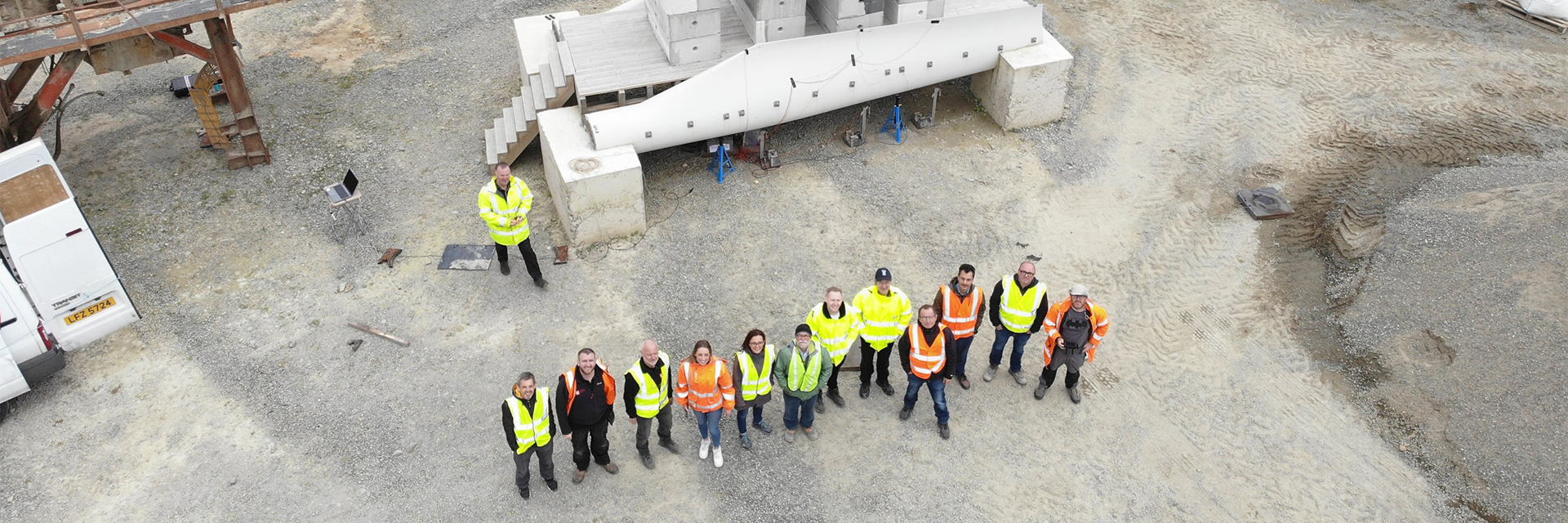
Photo: Conor Graham, from the Re-Wind Network
Pioneering a new recycling approach led to a big win for Re-Wind USA, a Georgia Tech research team led by Russell Gentry. The team has won the first phase of the Department of Energy's Wind Turbine Materials Recycling Prize, receiving $75,000 and an invitation to compete in the final phase.
"Our innovation for end-of-service wind turbine blades is both simple and elegant – at its core, our technology captures all the embodied energy in the composite materials in the blade," said Gentry, professor in the School of Architecture.
"The Re-Wind Network has pioneered structural recycling, the only of a number of competing technologies that upcycles the material of the blade and preserves the embodied energy from manufacturing," Gentry said.
"Little additional energy is used to remanufacture the blade and the life of the blade, typically 20 years, is extended at least 50 years. This is a win-win solution from an environmental and economic perspective."
Other methods for dealing with decommissioned wind blades involve mechanical grinding and landfilling of subsequent waste, an expensive and energy-intensive process, he said.
Team members include Gentry, Sakshi Kakkad, Cayleigh Nicholson, Mehmet Bermek, and Larry Bank, from the School of Architecture; Gabriel Ackall, Yulizza Henao, and Aeva Silverman, from the School of Civil and Environmental Engineering; and Eric Johansen, a business consultant from Fiberglass Trusses Inc.
The team is part of the Re-Wind Network, a multinational research and development network which develops large-scale infrastructure projects from decommissioned wind turbine blades.
Re-Wind's pedestrian bridges, known as BladeBridges, have already captured media attention. Two more BladeBridges are expected in Atlanta in 2024, Gentry said. Re-Wind has also developed, prototyped, and tested transmission poles made from blade segments. The team's other proposals include culverts, barriers, and floats.
Ann Hoevel, Director of Communications, College of Design
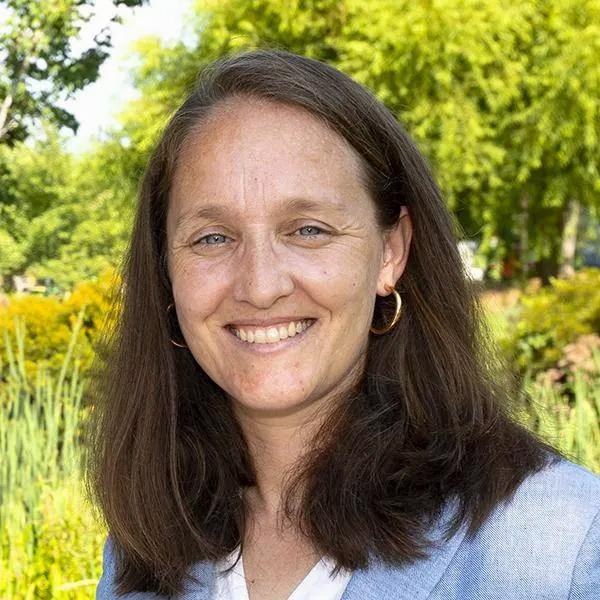
Associate Professor Marta Hatzell has won a 2024 ACS Sustainable Chemistry & Engineering Lectureship Award, which recognizes leading contributions of scientists and engineers active in the general fields of green chemistry, green engineering, and sustainability in the broadest sense of the chemical enterprise.
Hatzell, who holds joint appointments in Georgia Tech's School of Mechanical Engineering and School of Chemical and Biomolecular Engineering, was honored for her multiple contributions that drive the application of electrochemistry to enable critical systems with enhanced circularity.
The ACS Sustainable Chemistry & Engineering Lectureship awards were created to celebrate early to midcareer investigators who completed academic training no more than 10 years prior to nomination. In support of their commitment to nurture and stimulate a global community of outstanding practice. ACS Sustainable Chemistry & Engineering and the ACS Green Chemistry Institute gave three Lectureship Awards to recognize outstanding levels of contribution from The Americas, Europe/Middle East/Africa, and Asia/Pacific.
The award recipients will be honored at a joint plenary session of the 28th Annual Green Chemistry & Engineering Conference in their honor (June 3–5, 2024; https://www.gcande.org/).
Brad Dixon, Communications Manager, School of Chemical and Biomolecular Engineering
Members of the Georgia Tech community are opening their doors once again as part of the 11th annual Atlanta Science Festival. This year, Science and Engineering Day at Georgia Tech will serve as the kickoff event for the entire festival!
Some Georgia Tech researchers solve cosmic mysteries such as how supermassive black holes were born — and others now are getting a better, sharper look at those black holes.
A regional consortium led by the Georgia Institute of Technology, the University of Georgia, and Georgia State University, in collaboration with the Georgia Mining Association, will host an inaugural workshop on Georgia partnerships for Essential Minerals (GEMs). The one-day workshop is planned for Thursday, Feb. 1, at the University of Georgia Hotel and Conference Center and is expected to be the first in a series of critical mineral conversations hosted in rotation by the partner institutions. The event will bring together 40 participants from academia, industry, and government to discuss the opportunities and challenges around critical mineral supplies in the state and in the nation.
The GEMs workshop is driven by the compelling needs around domestic critical mineral supply for the energy and transportation sectors, and by the potentially significant rare earth element resources available in the state of Georgia. The workshop will couple the research capabilities of the three Georgia R1 research universities and the mature mining industry in Georgia to solve the challenges around this issue. It will engage all stakeholders with interests in resource exploration, technology development, energy and environmental sustainability, economic development, regulatory compliance, and workforce development toward achieving national security independence for critical mineral supply. The first workshop will focus on the production of the critical mineral resource, rare earth elements (REE), from kaolin mine tailings, overburden, and other potential processing streams. Other areas of REE production may also be considered.
The goal of the workshop is to produce a statement of outcomes regarding the current state of knowledge, opportunities, challenges, and possible pathways for GEMs. It will also serve as a catalyst to drive conversations among the key stakeholders to make an impact in GEMs, including developing university-industry-government partnership grants, internships, sponsored research, and training opportunities for the current and next generation of Georgia residents. These relationships will play an important role in creating reliable domestic supplies of critical minerals.
If you are interested in participating in the workshop, or have any other questions, please reach out to the Georgia Tech Strategic Energy Institute via email at comments@energy.gatech.edu or Professor Paul Schroeder at the University of Georgia by email at schroe@uga.edu.
Priya Devarajan || Research Communications Program Manager, SEI
Ann Dunkin
Chief Information Officer
U.S. Department of Energy
A two-time ISyE graduate, Dunkin oversees DoE’s cybersecurity and information technology. She'll share insights from her work and take questions during this fireside chat with Engineering Dean and Southern Company Chair Raheem Beyah.
Dunkin will talk about DoE’s technology innovation and digital transformation efforts, plus her experiences as:
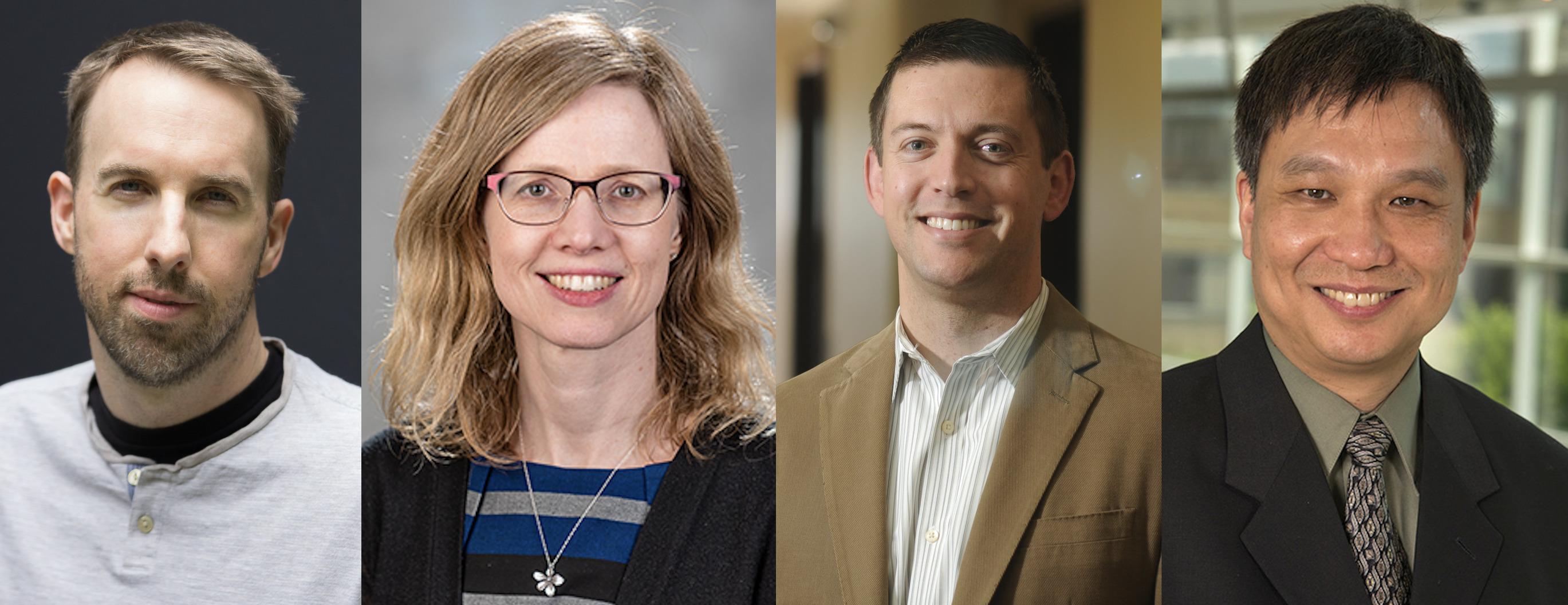
Four faculty members have been selected for the second cohort of the Faculty Executive Leadership Academy (FELA) program, which is designed to identify and develop senior faculty members for leadership. The new cohort includes:
David Ballantyne, Professor and Associate Chair for Academic Programs, School of Physics
Martha Grover, Professor and Associate Chair for Graduate Studies, School of Chemical and Biomolecular Engineering, and ADVANCE Professor in the College of Engineering
Aaron Levine, Professor, School of Public Policy, and Associate Dean for Research and Outreach, Ivan Allen College of Liberal Arts
Han Zhang, Steven A. Denning Professor of Technology and Management, Scheller College of Business
This program will build on the Fellows’ previous leadership experiences by providing access to senior leadership and their decisions; creating opportunities for them to interact with academic leaders from across the nation; offering close, and accessible mentoring with a cohort learning model; and participating in the formulation of project-based solutions and policies related to real problems and ongoing issues. FELA is led by former provost and executive vice president for Academic Affairs Rafael Bras.
“More than ever before, the health and future of higher education depends on good, experienced leaders with a broad understanding of many issues,” said Bras. “FELA is designed as an immersive program to develop that experience and understanding. Georgia Tech is investing in its future by developing the leadership talents of its senior faculty.”
This cohort of FELA Fellows will serve a two-year term beginning in July 2024. During their FELA experience, Fellows will rotate every six months into one of the four Executive Leadership Team offices – the Office of the President, Office of the Provost, Office of the Vice President for Research, and Office of the Vice President for Administration and Finance. In addition to shadowing and project work during these rotations, Fellows will participate in regular cohort meetings with Bras for leadership guest speakers, case studies, and role play activities to further ground their experience.
“Georgia Tech fosters the careers of thousands of the brightest faculty minds in higher education,” said Steve McLaughlin, provost and executive vice president for Academic Affairs. “These four new members of our Faculty Executive Leadership Academy represent those who wish to step forward as future leaders and learn what it takes to support the work of a university on an executive level. We look forward to working alongside them in the coming months.”
Learn more about the FELA program and members of the first and second cohorts.
Rebecca Pope-Ruark
Director of the Office of Faculty Professional Development

New research from Dylan Brewer, an assistant professor at Georgia Tech's School of Economics, and Samantha Cameron, an alumna of the School and Ph.D. student at the University of California-Davis, suggests that pausing recycling programs may not have long-term effects on recycling habits.
Their new paper, published in the Journal of Policy Analysis and Management, is "the first empirical test of the hypothesis that recycling habits will degrade if recycling programs are not maintained," the researchers said.
Brewer and Cameron examined a natural experiment in New York City, where the government paused the recycling program from 2002 to 2004. By comparing recycling rates in New York City to rates in Massachusetts and New Jersey, where recycling continued uninterrupted, the researchers found that "from 2006 to 2008, [NYC] recycling rates were unaffected by the pause. The finding of a quick rebound in recycling is consistent with persistent skills and habits in recycling."
Recycling is often unprofitable, so this is a valuable insight for policymakers weighing the management and continuity of recycling programs during economic fluctuations.
While cities maintain recycling programs during unprofitable periods for many reasons — it preserves environmental benefits and can prepare for future program profitability despite potential short-term financial strains — Brewer and Cameron's study shows that continuing programs over concerns that workers and people using the service will lose their recycling skills may be unfounded.
Still, there are some caveats. NYC is unique in many ways, including a 1989 law making recycling mandatory. However, a closer look by the researchers showed that law enforcement did not heavily influence the return to recycling. Instead, habit and skill retention, pause duration, continuous waste collection programs — NYC still collected paper, metal, and organic material during the pause — and the simplicity of recycling processes played pivotal roles. Still, the researchers recommend further exploration to understand habit persistence in recycling behaviors across diverse settings.
"Our results are relevant to policymakers considering whether to discontinue an unprofitable arm of a municipal recycling program," Brewer and Cameron conclude. "This natural experiment suggests that recycling rates can recover quickly, at least when the pause is short, and other municipal waste services continue. The quick recovery implies that policymakers need not be concerned that recycling rates will take a long time to rebuild."
“Habit and Skill Retention in Recycling” was published in the Journal of Policy Analysis and Management in November 2023. It is available at https://doi.org/10.1002/pam.22554
Ivan Allen College of Liberal Arts