From Watts to Warheads: Secretary of Energy Oversees Big Science Research and the US Nuclear Arsenal

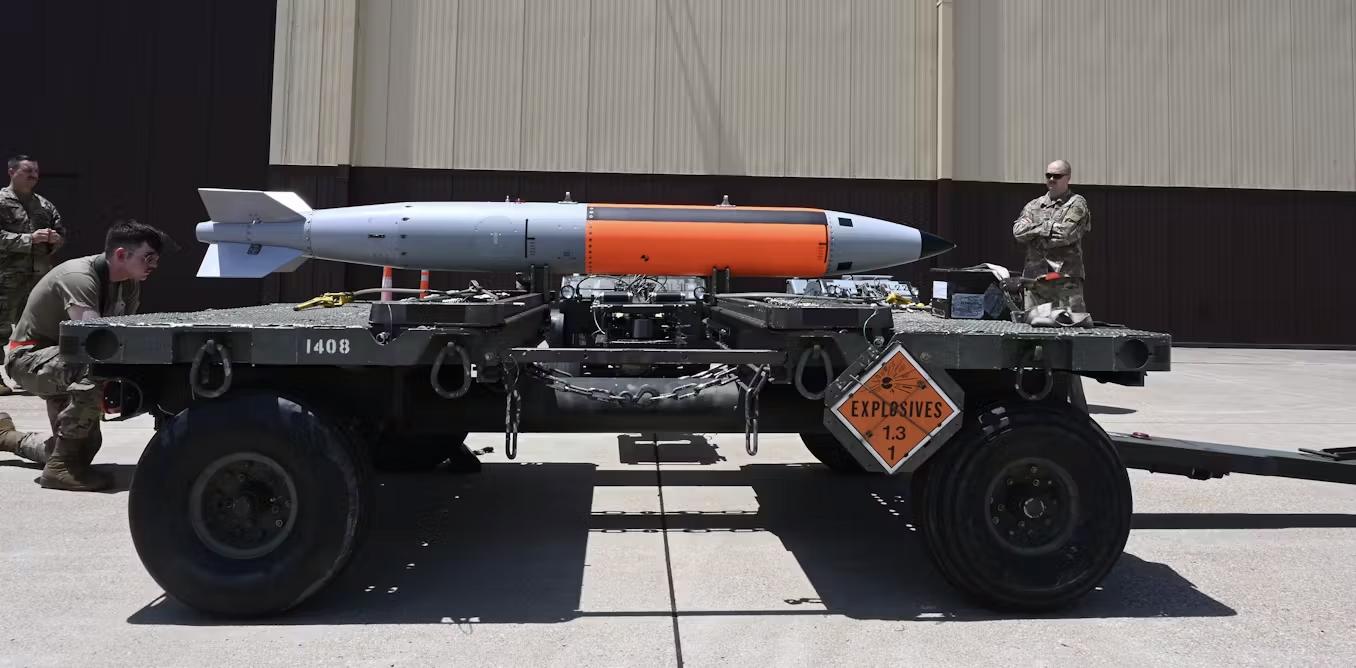
 The Energy Department recently finished modernizing the B61-12 nuclear bomb, extending its service life by at least 20 years. Devan Halstead, U.S. Air Force

The Energy Department recently finished modernizing the B61-12 nuclear bomb, extending its service life by at least 20 years. Devan Halstead, U.S. Air Force

The U.S. Department of Energy was created in 1977 by merging two agencies with different missions: the Atomic Energy Commission, which developed, tested and maintained the nation’s nuclear weapons, and the Energy Research and Development Administration, a collection of domestic energy research programs.

Today the department describes itself, with what some might call understatement, as “one of the most interesting and diverse agencies in the Federal government.” Its annual budget of roughly US$50 billion supports some 14,000 employees and 95,000 contractors.

The secretary of energy advises the president on energy policy and guides energy and nuclear weapons production initiatives. As researchers who study energy efficiency and national security and who work with the Energy Department, we have seen that its secretary needs to be able to think long-term and make strategic decisions, sometimes with incomplete information. A good grasp of science, engineering and energy technology is helpful, as are the abilities to lead a large organization and to work with Congress.

Scientific research and development

The Energy Department’s Office of Science supports a large portion of basic U.S. scientific research, including fusion energy, particle physics, chemistry and material science. Together with the agency’s Office of Energy Efficiency and Renewable Energy, the agency manages a research portfolio with a budget of roughly $12 billion – nearly as large as that of the U.S. National Science Foundation, the other major federal funder of basic research.

Many energy secretaries have made their greatest marks by supporting and directing research. For example, during the first Trump administration, Rick Perry recognized potential cyber-terrorism risks to U.S. energy infrastructure and supported research in artificial intelligence. This led to the creation of the agency’s Office of Cybersecurity, Energy Security and Emergency Response.

Steven Chu, who led the department from 2009 to 2013 under former President Barack Obama, initiated the Advanced Research Projects Agency–Energy, or ARPA-E, a division that focuses on new, cutting-edge energy innovations at stages too early to attract private-sector investment. ARPA-E projects have led to the creation of over 100 new companies and to over 1,000 patents on a wide range of energy technologies, including hybrid-electric aircraft, carbon dioxide capture from the air and improved electricity transmission.

Most recently, during the Biden administration, Jennifer Granholm focused on working with business and industry to deploy clean energy technologies in support of U.S. climate goals. This effort has included offering grants, loans and rebates, filling gaps in supply chains, and promoting domestic manufacturing of components such as advanced batteries and solar panels.

During the Biden administration, the Energy Department offered large-scale grants and loans to promote domestic manufacturing of clean energy technologies, such as advanced batteries.

Research payoffs

Much of the research that the Energy Department funds can take years to produce results with commercial applications, but it has had some notable successes.

Since the late 1970s, the agency has invested significantly in shale oil research. Combined with additional research and development by private energy companies, the Energy Department helped develop fracking and horizontal drilling. These technologies have revolutionized petroleum and natural gas production and made the U.S. the world’s largest producer of oil and natural gas.

Energy Department funding supported the commercialization of LED lights, which are highly efficient and long-lasting. It also has enabled breakthroughs in other energy-efficient technologies, solar and wind energy production, battery technology, and geothermal and wave energy. The agency provides critical support for research on nuclear fusion, which promises to be a clean and abundant source of energy, although it is far from commercialization today.

There also are large swaths of U.S. energy policy that the Energy Department doesn’t control. For example, leases and permits for energy production on public lands and in federal waters are awarded by the Department of the Interior.

The Federal Energy Regulatory Commission, an independent agency, controls the siting of oil and natural gas pipelines and interstate electricity transmission lines. Another independent agency, the Nuclear Regulatory Commission, licenses and regulates the nuclear power industry.

Still, energy secretaries often champion broad strategies that overlap with the mission and authority of other federal departments and agencies.

Nuclear weapons and national security

The Energy Department’s other mission – developing and maintaining nuclear weapons – is steered by the National Nuclear Security Administration, a semi-autonomous agency within the department. Organizationally, the NNSA is the great-grandchild of the Manhattan Engineer District – the post-World War II incarnation of the Manhattan Project that developed the first U.S. atomic weapons.

The NNSA is headed by an administrator who also serves as undersecretary of energy for nuclear security, a Senate-confirmed position. When the energy secretary’s background is in domestic energy – like oil executive Chris Wright, President-elect Trump’s choice to head the agency – the leader of the NNSA is likely to be especially influential on national security issues.

Of the Energy Department’s 17 national laboratories, three – Los Alamos, Sandia and Lawrence Livermore – are officially overseen by the NNSA. Others receive significant NNSA funding and play roles in maintaining the U.S. nuclear arsenal.

The NNSA also oversees experimental and testing facilities and other sites involved in the design, production and testing of nuclear weapons. It is responsible for storing and securing warheads that are not deployed at military installations, and for dismantling retired warheads.

A separate office, Environmental Management, oversees the cleanup of nuclear research and production sites, some of which have contamination dating back to World War II. The largest environmental cleanup program in the world, it consumes about $8 billion annually – one-sixth of the agency’s entire budget. It handles large amounts of radioactive wastes, spent nuclear fuel, excess plutonium and uranium, and contaminated facilities, soil and groundwater.

The NNSA plays a critical role in preventing the spread of nuclear weapons and the materials and technologies needed to make them. It is part of the intelligence community with deep technical expertise, and responds to nuclear and radiological threats globally.

Finally, the NNSA designs and supports the nuclear reactors that propel Navy ships and submarines around the globe.

Historically, the NNSA administrator has had a great deal of autonomy. Most administrators bring deep technical and policy expertise to the job. Some are retired Navy or Air Force officers who have worked with nuclear weapons or naval propulsion systems. Others are researchers with long tenures at Department of Energy laboratories.

Aging weapons, sites and workers

The next energy secretary and NNSA administrator will face major technical, economic and management challenges. The NNSA has been working for years to modernize nuclear weapons production infrastructure, which is aging and underfunded. At the same time, the Energy Department is working with the Defense Department to update U.S. nuclear weapons and strategic nuclear forces – bombers, ballistic missiles and submarines – to deter threats from other nations. This effort could cost up to $1.7 trillion over several decades.

Replacing aging Minuteman intercontinental ballistic missiles is just one component of a large-scale modernization of U.S. nuclear forces.

Many of the NNSA’s major modernization projects are over budget and years behind schedule. The U.S. Government Accountability Office recently reported that the NNSA needs to improve its program management practices in order to control costs and successfully execute these expensive initiatives.

The incoming administration will also have to recruit and sustain a highly skilled workforce for nuclear security programs. Many retirement-eligible employees have already left the agency. More will exit over the next four years, often drawn by private-sector salaries and perceived better working conditions.

While the Energy Department touts its high-tech laboratories and research facilities, the agency’s people are equally critical to its mission.

This story is part of a series of profiles of Cabinet and high-level administration positions.The Conversation


This article is republished from The Conversation under a Creative Commons license. Read the original article.


 
News Contact
Author:

Valerie Thomas, Professor of Industrial Engineering, Georgia Institute of Technology and Margaret E. Kosal, Associate Professor of International Affairs, Georgia Institute of Technology

Media Contact:

Shelley Wunder-Smith
shelley.wunder-smith@research.gatech.edu

Georgia Tech Faculty Members Earn Presidential Awards

Juan-Pablo Correa-Baena and Josiah Hester

Juan-Pablo Correa-Baena and Josiah Hester

Two Georgia Tech professors have earned the Presidential Early Career Award for Scientists and Engineers, the highest honor bestowed by the U.S. government on early-career engineers and scientists. 

Juan-Pablo Correa-Baena, associate professor and Goizueta Early Career Faculty Chair in the School of Materials Science and Engineering, and Josiah Hester, associate professor in the School of Interactive Computing, are among this year's nearly 400 honorees.   

Correa-Baena is recognized for his solar cell and semiconductor research with the U.S. Department of Energy. His research group focuses on understanding the relationship between chemistry, crystallographic structure, and properties of new, low-cost semiconducting materials used for optical and electronic applications. His team also works on advanced techniques for characterizing these very small materials and their interactions. 

“I wanted to research something that would benefit society while also using chemistry, physics, and involved materials discovery to inform that. That is why I work on solar cells — because this area of research is so important,” said Correa-Baena.  

Correa-Baena leads a solar energy materials research initiative for Georgia Tech’s Institute for Matter and Systems and the Strategic Energy Institute. He also has a secondary appointment in the School of Chemistry and Biochemistry.  

“My career goal has always been to execute high-quality research,” he said. “Receiving this award is a testament to the work our lab is doing, my student and faculty collaborators at Georgia Tech, and simply being in the right place at the right time.” 

Read more about Correa-Baena’s work. 

Hester said his nomination was based on the National Science Foundation Faculty Early Career Development Program award he received in 2022 as an assistant professor at Northwestern University.  

“For me, I always thought this was an unachievable, unassailable type of thing because of the reputation of the folks in computing who’ve won previously,” Hester said. “It was always a far-reaching goal. I was shocked. It’s something you would never in a million years think you would win.” 

Hester is known for pioneering research in a new subfield of sustainable computing dedicated to creating battery-free devices powered by solar energy, kinetic energy, and radio waves. He co-led a team that developed the first battery-free handheld gaming device

Last year, he co-authored an article published in the Association of Computing Machinery’s in-house journal, the Communications of the ACM, in which he coined the term “Internet of Batteryless Things.” 

The Presidential Early Career Award for Scientists and Engineers was established by President Bill Clinton in 1996. It honors individuals for their contributions to science and technology and promotes awareness of STEM careers. The award also supports the missions of participating agencies and strengthens the link between research and societal impact. This year’s winners will be invited to visit the White House later this year.


Georgia Tech 2025 Sustainability Showcase - Day 2

The theme for this year’s showcase is ecosystem, community, and infrastructure resilience, as well as resilience in the curriculum. This is an exciting opportunity to learn about this critical work happening all across campus, and the SE region. Visit the Showcase web page to learn about the schedule of events as it develops.

Georgia Tech 2025 Sustainability Showcase - Day 1

Sponsored by Brook Byers Institute for Sustainable Systems, this event will be an opportunity for Georgia Tech academics, researchers, students, and Institute programs to share their work in sustainability.

Why Does a Rocket Have to go 25,000 mph to Escape Earth?

 A SpaceX Falcon 9 rocket with its Crew Dragon capsule launches from Cape Canaveral, Fla., in January 2024. Chandan Khanna/AFP via Getty Images

A SpaceX Falcon 9 rocket with its Crew Dragon capsule launches from Cape Canaveral, Fla., in January 2024. Chandan Khanna/AFP via Getty Images

Why does a rocket have to go 25,000 mph (about 40,000 kilometers per hour) to escape Earth? – Bo H., age 10, Durham, New Hampshire


There’s a reason why a rocket has to go so fast to escape Earth. It’s about gravity – something all of us experience every moment of every day.

Gravity is the force that pulls you toward the ground. And that’s a good thing. Gravity keeps you on Earth; otherwise, you would float away into space.

But gravity also makes it difficult to leave Earth if you’re a rocket heading for space. Escaping our planet’s gravitational pull is hard – not only is gravity strong, but it also extends far away from Earth.

Like a balloon

As a rocket scientist, one of the things I do is teach students how rockets overcome gravity. Here’s how it works:

Essentially, the rocket has to make thrust – that is, create force – by burning propellant to make hot gases. Then it shoots those hot gases out of a nozzle. It’s sort of like blowing up a balloon, letting go of it and watching it fly away as the air rushes out.

A bird's eye view of a rocket blasting off.

On July 16, 1969, a Saturn V rocket sent Apollo 11 and three American astronauts on their way to the Moon. Heritage Images/Hulton Archive via Getty Images

More specifically, the rocket propellant consists of both fuel and oxidizer. The fuel is typically something flammable, usually hydrogen, methane or kerosene. The oxidizer is usually liquid oxygen, which reacts with the fuel and allows it to burn.

When going into space and escaping from Earth, rockets need lots of force, so they consume propellant very quickly. That’s a problem, because the rocket can’t carry enough propellant to keep thrusting forever; the amount of propellant needed would make the rocket too heavy to get off the ground.

So what happens when the propellant runs out? The thrust stops, and gravity slows the rocket down until it gradually begins to fall back to Earth.

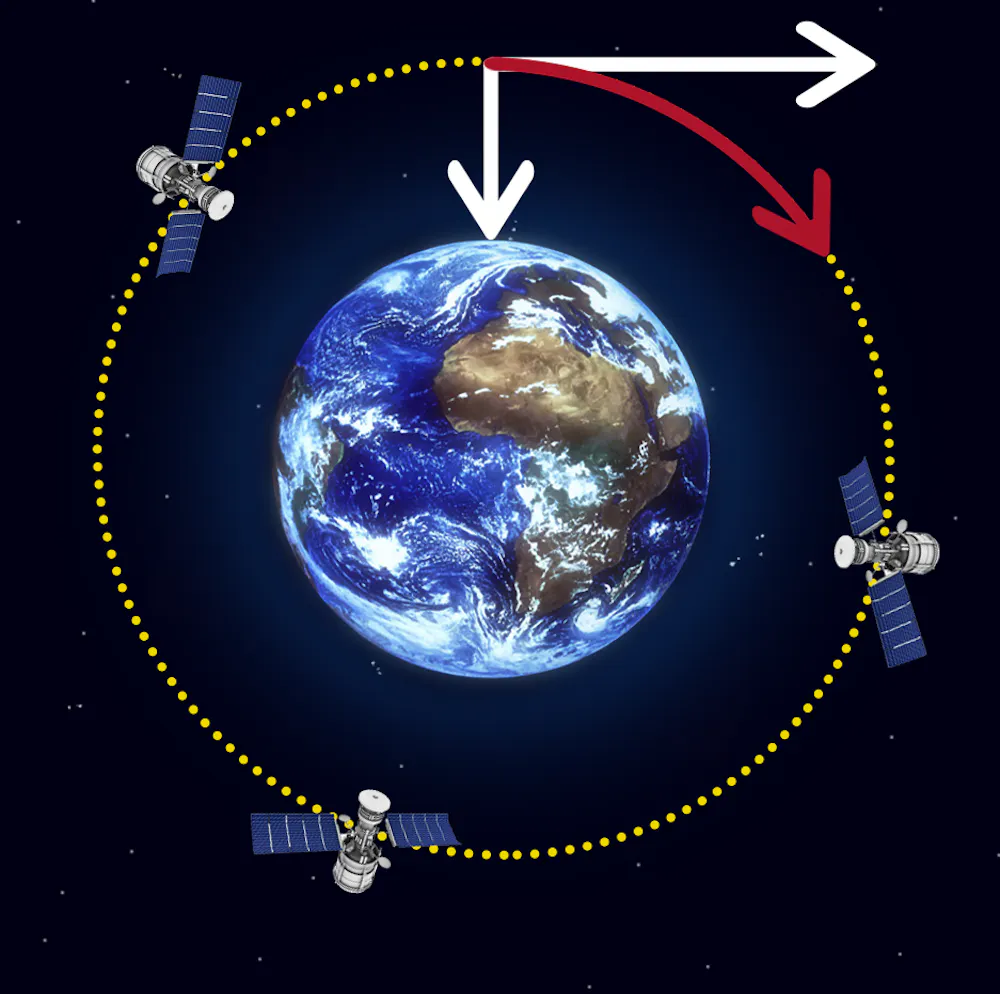
A diagram that shows a satellite orbiting the Earth.

A rocket provides the spacecraft with a sideways push (right arrow), gravity pulls it toward Earth (down arrow), and the resulting motion (red arrow) puts the spacecraft into orbit (yellow path). ESA/ L. Boldt-Christmas

Fortunately, scientists can launch the rocket with some sideways momentum so that it misses the Earth when it returns. They can even do this so it continuously falls around the Earth forever. In other words, it goes into orbit, and begins to circle the planet.

Many launches intentionally don’t completely leave Earth behind. Thousands of satellites are orbiting our planet right now, and they help phones and TVs work, display weather patterns for meteorologists, and even let you use a credit card to pay for things at the store or gas at the pump. You can sometimes see these satellites in the night sky, including the International Space Station.

An Atlas V rocket took NASA’s Perseverance rover to Mars.

Escaping Earth

But suppose the goal is to let the rocket escape from Earth’s gravity forever so it can fly off into the depths of space. That’s when scientists do a neat trick called staging. They launch with a big rocket, and then, once in space, discard it to use a smaller rocket. That way, the journey can continue without the weight of the bigger rocket, and less propellant is needed.

Against a blue sky, a rocket shoots off into space.

The launch of a SpaceX Falcon 9 rocket from Cape Canaveral, Fla., in May 2024. The rocket carried 23 Starlink satellites into low Earth orbit. Joe Raedle via Getty Images

But even staging is not enough; eventually the rocket will run out of propellant. But if the rocket goes fast enough, it can run out of propellant and still continue to coast away from Earth forever, without gravity pulling it back. It’s like riding a bike: build up enough speed and eventually you can coast up a hill without pedaling.

And just like there’s a minimum speed required to coast the bike, there’s a minimum speed a rocket needs to coast away into space: 25,020 mph (about 40,000 kilometers per hour).

Scientists call that speed the escape velocity. A rocket needs to go that fast so that the momentum propelling it away from Earth is stronger than the force of gravity pulling it back. Any slower, and you’ll go into an orbit of Earth.

Escaping Jupiter

Bigger, or more massive, objects have stronger gravitational pull. A rocket launching from a planet bigger than Earth would need to achieve a higher escape speed.

For example, Jupiter is the most massive planet in our solar system. It’s so big, it could swallow 1,000 Earths. So it requires a very high escape speed: 133,100 mph (about 214,000 kilometers per hour), more than five times the escape speed of Earth.

But the extreme example is a black hole, an object so massive that its escape speed is extraordinarily high. So high, in fact, that even light – which has a speed of about 670 million mph (over a billion kilometers per hour) – is not fast enough to escape. That’s why it’s called a black hole.

The Conversation


This article is republished from The Conversation under a Creative Commons license. Read the original article.

 
News Contact
Author:

Benjamin L. Emerson, Principal Research Engineer, Daniel Guggenheim School of Aerospace Engineering, Georgia Institute of Technology

Media Contact:

Shelley Wunder-Smith
shelley.wunder-smith@research.gatech.edu

Atlanta CleanTech Connect - Q12025: The Energy Water Nexus

The ATL CleanTech Connect meets quarterly to engage members of the Greater Atlanta clean tech community to support innovation, ideation, startups and investment in clean tech and sustainability focused businesses. Industry, venture capitalists, Georgia Tech faculty and local leaders lead conversations related to cleantech opportunities in the region. We eagerly look forward to your positive response and your valuable presence at this event.

2025 Southeastern Energy Conference - Day 2

The Southeastern Energy Conference, hosted by the Energy Club, is an annual two-day event dedicated to discussion of the energy industry. The conference includes expert guest speakers from across the field, an industry showcase of world-renowned companies, and a student poster competition. Keynote speakers include John Tien, former Deputy Secretary of Homeland Security, and Lonnie Johnson, famed inventor of the Super Soaker and founder of Johnson R&D and Johnson Battery Technologies.

2025 Southeastern Energy Conference - Day 1

2025 Conference Vision: Energy is at the root of almost everything we do, and it only makes sense that such a vital resource plays a central role in international politics. Whether it is the weaponization of the power grid during Russia’s war in Ukraine or the challenge of cooperating on climate goals, energy is at the core of the geopolitical landscape. The 2025 Georgia Tech Energy Conference will explore the intersection between energy and geopolitics, discussing the ways in which energy shapes how countries interact.

AI’s Energy Demands Spark Nuclear Revival

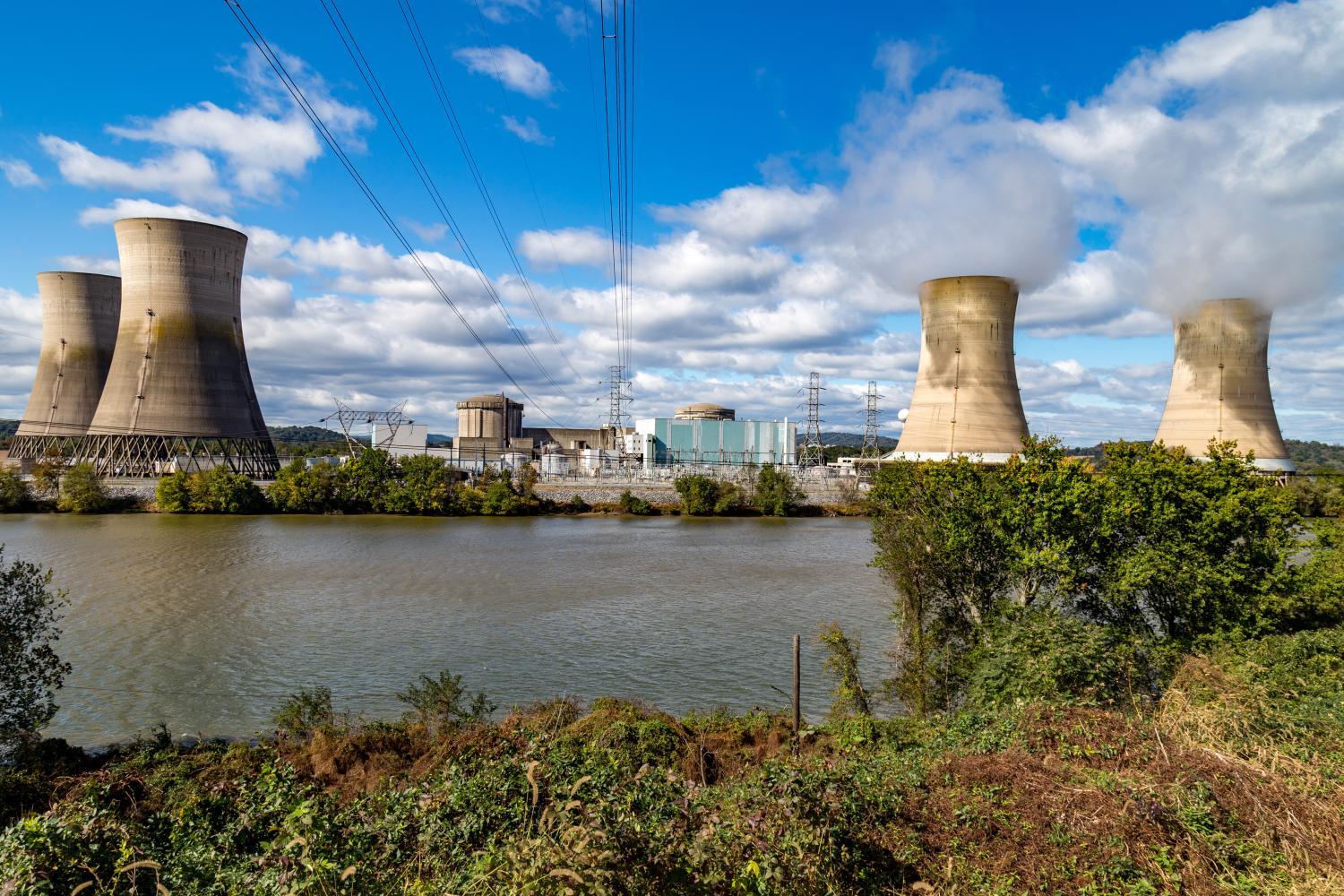
Image of Three Mile Island

The demand for electricity to power AI data centers is skyrocketing, placing immense pressure on traditional energy sources.  

“If we continue pursuing clean energy for AI and data centers, we will need to triple the energy supply for data centers by 2030,” says Woodruff Professor Anna Erickson, a nuclear engineering expert from Georgia Tech. Nuclear power, with its high energy density and continuous operation, is well-suited to provide the steady base load of electricity required. 

According to Erickson, the recent headlines of the restarting of Pennsylvania’s Three Mile Island Unit 1 reactor (TMI-1) could play a crucial role in meeting these demands sustainably. 

This decision, supported by a 20-year agreement with Microsoft, aims to provide carbon-free energy to meet the escalating power demands of AI data centers. The company’s goal to be carbon negative by 2030 aligns with the broader push for sustainable energy solutions.  

According to the United States Energy Information Administration, as of Aug. 1, 2023, the United States has 93 operating commercial nuclear reactors across 54 nuclear power plants in 28 states. The most recent reactor to begin commercial operation is Unit 4 at the Alvin W. Vogtle Electric Generating Plant in Georgia, which started on April 29, 2024. 

The commercial start of Unit 4 completes the 11-year expansion project at Plant Vogtle.

A Historic Site With a New Mission 

Three Mile Island, infamous for the 1979 partial meltdown of its Unit 2 reactor, has remained a symbol of nuclear caution. However, the reopening of TMI-1, which operated safely for decades before its 2019 shutdown due to financial constraints, represents a potential renaissance for nuclear power. The plant’s revival is seen as a strategic move to address the increasing strain on conventional electricity grids, exacerbated by the energy-intensive needs of AI technologies. 

Expert Insights on Safety and Innovation 

Erickson stresses the importance of rigorous safety measures and technological upgrades in the reopening process.  

“Reopening TMI-1 will require addressing several critical safety concerns, primarily focused on aging infrastructure and modern regulatory standards,” she explains. Comprehensive inspections and upgrades to emergency cooling, radiation monitoring, and digital control systems will be essential to ensure structural integrity and operational reliability. 

Erickson notes, “We can expect to see developments in advanced radiation detection, novel sensors, and AI-driven security systems.” These technologies not only enhance safety but also improve the efficiency and reliability of nuclear power plants. She also highlights the potential for innovative advancements in reactor technology.  

Economic and Environmental Implications 

The reopening of TMI-1 is expected to bring notable economic advantages. According to Erickson, upgrading existing infrastructure is likely to be more cost-effective than new construction and can be completed more quickly.  

“The implications of restarting are significant,” she explains. “It supports clean energy goals and provides a reliable power source for the growing needs of data centers.” 

Environmental considerations are also paramount. The plant’s carbon-free energy production aligns with efforts to combat climate change and reduce greenhouse gas emissions.  

“Nuclear energy is a clean and reliable power source that can help us achieve our climate goals while meeting the growing energy demands of AI,” Erickson emphasizes. 

Public Perception and Regulatory Oversight 

Despite the potential benefits, public perception of nuclear energy remains cautious, primarily due to historical incidents like the Three Mile Island accident. Erickson acknowledges these concerns and indicates the importance of transparent regulatory oversight and effective communication.  

She says the U.S. Nuclear Regulatory Commission (NRC) “does a lot to ensure safety and security, but as experts, we need to do a better job of explaining technological advances and the benefits of nuclear energy.”  

The reopening of TMI-1 is subject to approval from the NRC and other regulatory bodies, ensuring that all safety and environmental standards are met. 

 
News Contact

Siobhan Rodriguez 

Institute Communications