Joint Workshop Highlights Emerging Research at the Intersection of Sustainability, Mobility, and Health 

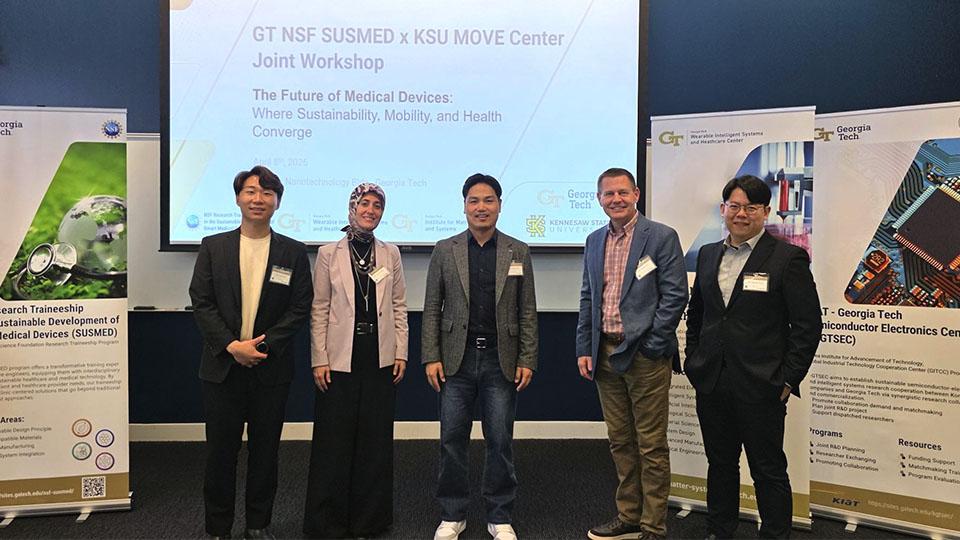
Six workshop organizers stand in front of a projected slide reading “GT NSF SUSMED x KSU MOVE Center Joint Workshop,” with Georgia Tech and Kennesaw State University banners visible on both sides.

Students, faculty, and researchers from Georgia Tech and Kennesaw State University gathered on April 8 for a joint workshop between Georgia Tech's NSF Sustainable Development of Smart Medical Devices (SUSMED) program and KSU's Mobility for Everyone (MOVE) Center. The full-day event explored how sustainable design, mobility science, and health technologies are converging to shape the next generation of medical devices.  

Hosted in Georgia Tech’s Marcus Nanotechnology Building, the workshop brought together trainees from the NSF SUSMED program and students from the MOVE Center for a day of presentations, posters, and hands‑on demonstrations.  

The event was co‑led by Hong Yeo, Peterson Professor in Pediatric Research in the George W. Woodruff School of Mechanical Engineering at Georgia Tech; Karam Kim, research faculty at the same school; and Ayse Tekes, associate professor in Mechanical Engineering at KSU.  

“I am thrilled to have hosted this first joint event between the NSF NRT in the WISH Center at Georgia Tech and the KSU MOVE Center. When I first envisioned it, I hoped it would spark meaningful conversations between students and researchers — but what unfolded far exceeded every expectation,” Yeo said. “This was not just a gathering; it was a launchpad for exciting new collaborative projects, dynamic student exchange programs, and bold, ambitious bets on the future of our field. A heartfelt thank you to IMS Director Eric Vogel, Josh Lee, the WISH Center program manager, and Karam Kim, research faculty extraordinaire — none of this would have been possible without their support.”  

A central goal of the workshop was to give students meaningful opportunities to present their research and engage with peers across disciplines. According to Tekes, who is the director of the MOVE Center, events like this play a critical role in shaping early career researchers.  

“I think these events are very eye-opening,” Tekes said. “They give students a real opportunity to showcase their results, but also to collaborate and learn about research outside their own area. Seeing work across disciplines sparks new questions and helps them think differently.”  

Throughout the day, students presented projects on wearable devices, mobility technologies, digital health tools, sustainable engineering approaches, and more. Tekes emphasized how valuable it is for students to practice communicating their work to a broad audience.  

“They are getting the practice to present their outputs — the key outcomes of their research — and explain the significance and importance,” she said. “They’re also learning to answer questions from different perspectives, because in this room you’re seeing engineers, computer scientists, and clinicians.”  

Due to the strong turnout and enthusiastic participation throughout the day, organizers are already planning another session next semester. By bringing together diverse expertise from both schools, the event highlighted the shared commitment to developing medical technologies that improve mobility, health, and quality of life.   

Funding sources: NSF NRT-FW-HTF: NSF Traineeship in the Sustainable Development of Smart Medical Devices (Award # 2345860) and WISH Center grant from the Institute for Matter and Systems 

 
News Contact

Ashlie Bowman | Communications Manager

Parker H. Petit Institute for Bioengineering and Bioscience

Written by Scarlett Smith

Atlanta Science Festival Kickoff at Georgia Tech | Celebrate STEAM

Georgia Tech is excited to kickoff off the 13th annual Atlanta Science Festival by welcoming the community to our campus to Celebrate STEAM! Attendees can participate in hands-on STEAM activities, watch science and technology demonstrations, connect with student researchers, and discover the exciting advancements happening at Georgia Tech.

A Step Forward: New Smart Shoe Insert Could Improve Mobility for People With Walking Problems

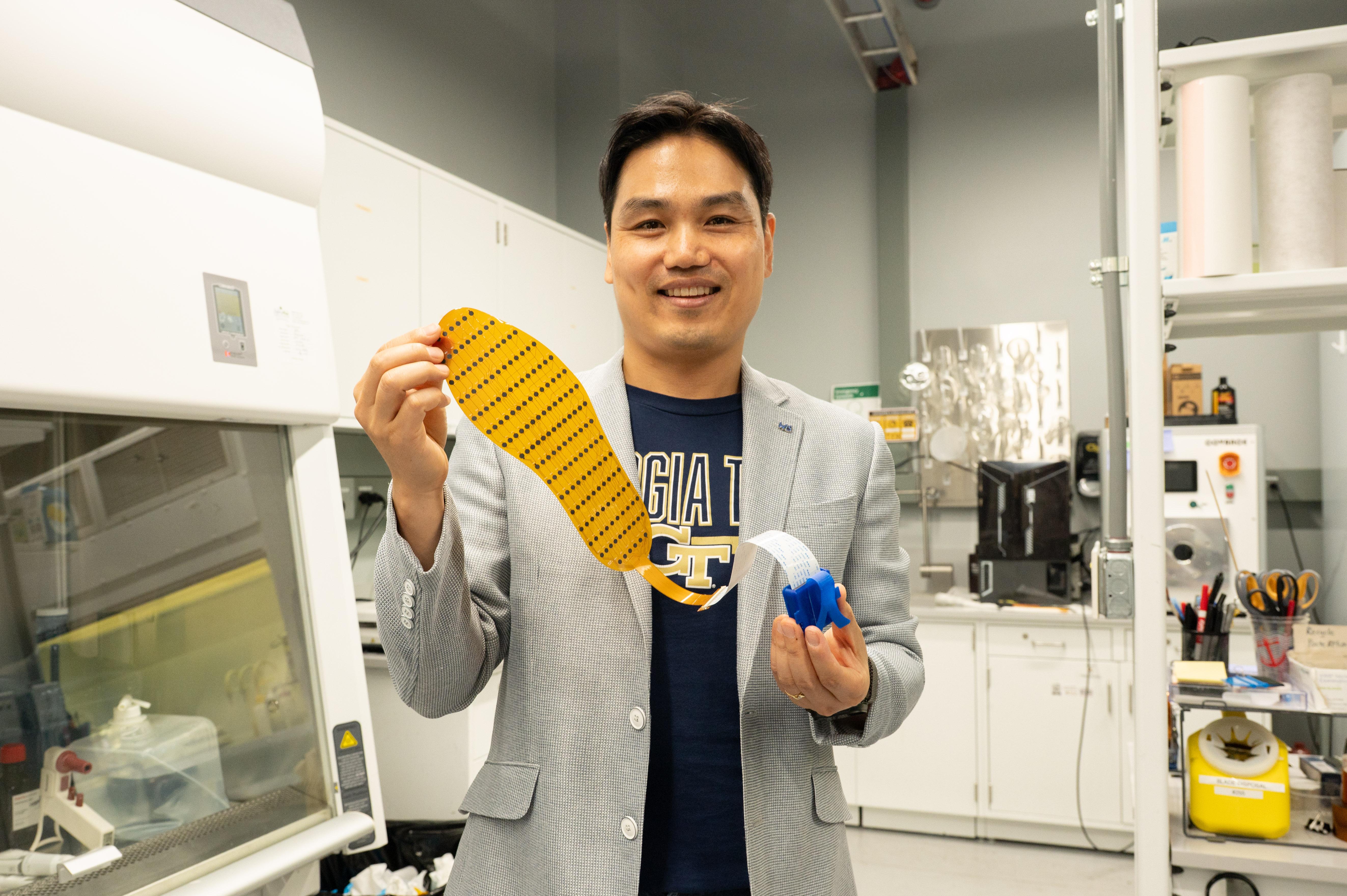
Hong Yeo holds shoe insert.

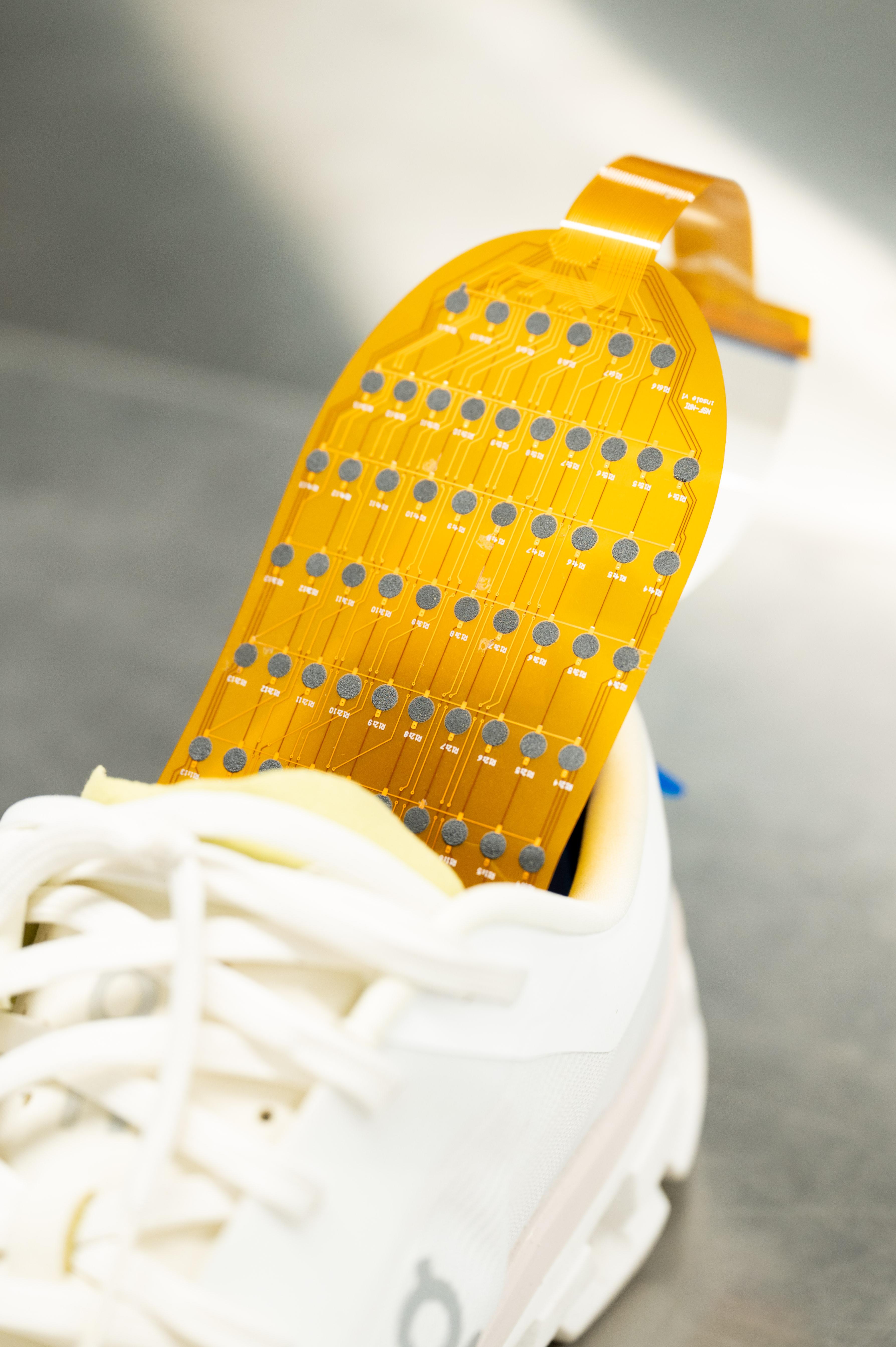
Hong Yeo holds the wearable electronic device made of more than 170 thin, flexible sensors that measure foot pressure — a key metric for determining whether someone is off-balance. [Photos by Joya Chapman]

Maintaining balance while walking may seem automatic — until suddenly it isn’t. Gait impairment, or difficulty with walking, is a major liability for stroke and Parkinson’s patients.  Not only do gait issues slow a person down, but they are also one of the top causes of falls. And solutions are often limited to time-intensive and costly physical therapy.

A new wearable electronic device that can be inserted inside any shoe may be able to address this challenge. The device, developed by Georgia Tech researchers, is made of more than 170 thin, flexible sensors that measure foot pressure — a key metric for determining whether someone is off-balance. The sensor collects pressure data, which the researchers could eventually use to predict which changes lead to falls.

The researchers presented their work in the paper, “Flexible Smart Insole and Plantar Pressure Monitoring Using Screen-Printed Nanomaterials and Piezoresistive Sensors.” It was the cover paper in the August edition of ACSApplied Materials & Interfaces

Pressure Points

Smart footwear isn’t new — but making it both functional and affordable has been nearly impossible. W. Hong Yeo’s lab has made its reputation on creating malleable medical devices. The researchers rely on the common commercial practice of screen-printing electronics to screen-print sensors. They realized they could apply this printing technique to address walking difficulties.

“Screen-printing is advantageous for developing medical devices because it's low-cost and scalable,” said Yeo, the Peterson Professor and Harris Saunders Jr. Professor in the George W. Woodruff School of Mechanical Engineering. “So, when it comes to thinking about commercialization and mass production, screen-printing is a really good platform because it's already been used in the electronics industry.”

Making the device accessible to the everyday user was paramount for Yeo’s team. A key innovation was making sure the wearable is thin enough to be comfortable for the wearer and easy to integrate with other assistive technologies. The device uses Bluetooth, enabling a smartphone to collect data and offer the future possibility of integrating with existing health monitoring applications.

Possibilities for real-world adaptation are promising, thanks to these innovations. Lightweight and small, the wearable could be paired with robotics devices to help stroke and Parkinson’s patients and the elderly walk. The high number of sensors could make it easier for researchers to apply a machine learning algorithm that could predict falls. The device could even enable professional athletes to analyze their performance.

Regardless of how the device is used, Yeo intends to keep its cost under $100. So far, with funding from the National Science Foundation, the researchers have tested the device on healthy subjects. They hope to expand the study to people with gait impairments and, eventually, make the device commercially available. 

“I'm trying to bridge the gap between the lack of available devices in hospitals or medical practices and the lab-scale devices,” Yeo said. “We want these devices to be ready now — not in 10 years.”

With its low-cost, wireless design and potential for real-time feedback, this smart insole could transform how we monitor and manage walking difficulties — not just in clinical settings, but in everyday life. 

Shoe insert
 
News Contact

Tess Malone, Senior Research Writer/Editor

tess.malone@gatech.edu

Georgia Tech Team Designing Robot Guide Dog to Assist the Visually Impaired

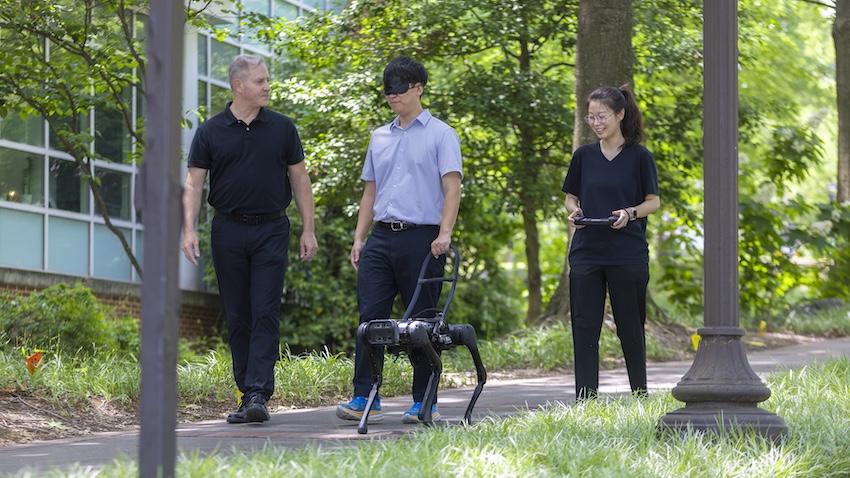
Georgia Tech researchers test their prototype of a robotic guide dog. Photo by Terence Rushin/College of Computing.

People who are visually impaired and cannot afford or care for service animals might have a practical alternative in a robotic guide dog being developed at Georgia Tech.

Before launching its prototype, a research team within Georgia Tech’s School of Interactive Computing, led by Professor Bruce Walker and Assistant Professor Sehoon Ha, is working to improve its methods and designs based on research within blind and visually impaired (BVI) communities.

“There’s been research on the technical aspects and functionality of robotic guide dogs, but not a lot of emphasis on the aesthetics or form factors,” said Avery Gong, a recent master’s graduate who worked in Walker’s lab. “We wanted to fill this gap.”

With training a guide dog costing up to $50,000, few BVI individuals can afford one, and even fewer can afford to care for and feed it. The dog also has fewer than 10 working years before it needs replacement.

Gong co-authored a paper on the design implications of the robotic guide dog that was presented at the 2025 International Conference on Robotics and Automation (ICRA) in Atlanta in May.

The consensus among the study’s participants indicates they prefer a robotic guide dog that:

  • resembles a real dog and appears approachable
  • has a clear identifier of being a guide dog, such as a vest
  • has built-in GPS and Bluetooth connectivity
  • has control options such as voice command
  • has soft textures without feeling furry
  • has long battery life and self-charging capability

“A lot of people said they didn’t want the dog to look too cute or appealing because it would draw too much attention,” said Aviv Cohav, another lead author of the paper and recent master’s graduate.

“Many people have issues with taking their guide dog to places, whether it’s little kids wanting to play with the dog or people not liking dogs or people being scared of them, and that reflects on the owners themselves. We wanted to look at what would be a good balance between having a functional robot that wouldn’t scare people away or be a distraction.”

The researchers also had to consider the perspectives of sighted individuals and how society at large might view a robotic guide dog.

An example of this is the amount of noise the dog makes while walking. The owner needs to hear the dog is active, but the clanky sound many off-the-shelf robots make could create disturbances in indoor spaces that amplify sounds. To offset the noise, the team developed algorithms that allow the robot to move more quietly.

Walker and his lab have examined similar scenarios that must take public perception into account.

“We like to think of Georgia Tech as going the extra mile,” Walker said. “Let’s not just make a robot, but a robot that’s going to fit into society.

“To have impact, the technologies we produce must be produced with society in mind. This is a holistic design that considers the users and all the people with whom the users interact.”

Taery Kim, a computer science Ph.D. student, began working on the concept of a robotic guide dog when she came to Georgia Tech in 2022. She and Ha, her advisor, have authored papers on building the robot’s navigation and safety components. 

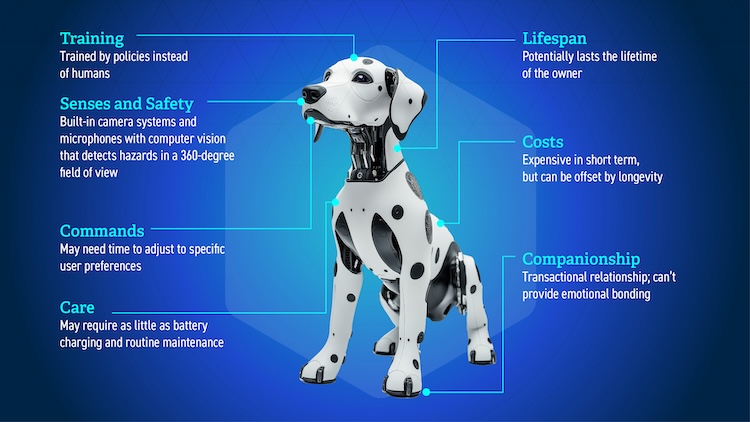
“When I started, I thought it would be as simple as giving the guide dog a command to take me to Starbucks or the grocery store, and it would just take me,” Kim said. “But the user must give waypoint directions — ‘go left here,’ ‘turn right,’ ‘go forward,’ ‘stop.’ Detailed commands must be delivered to the dog.”

While a real dog has naturally enhanced senses of hearing and smell that can’t be replicated, technology can provide interconnected safety features during an emergency. The researchers envision a camera system equipped with a 360-degree field of view, computer vision algorithms that detect obstacles or hazards, and voice recognition that recognizes calls for help. An SOS function could automatically call 911 at the owner’s request or if the owner is unresponsive.

Kim said the robot should also have explainability features to enhance communication with the owner. For example, if the robot suddenly stops or ignores an owner’s commands, it should tell the owner that it’s detecting a hazard in their path.

Manufacturing a robot at scale would initially be expensive, but the researchers believe the cost would eventually be offset because of its longevity. BVI individuals may only need to purchase one during their lifetime.

To introduce a prototype, the multidisciplinary research team recognizes that it needs to enlist experts from other fields to adequately address the various implications and research gaps inherent in the project.

Walker said the teams welcome additional partners who are keen to tackle challenges ranging from design and engineering to battery life to human-robot interaction.

A graphic depicts design considerations for the prototype.
 
News Contact

Nathan Deen, Communications Officer
School of Interactive Computing

nathan.deen@cc.gatech.edu

Faculty Talk: Shaping the Future of Space Research at Georgia Tech

IRIM Spring 2026 Seminar Series | Featuring - Amy Orsborn, University of Washington

Title: TBA


Abstract: TBA


IRIM Fall 2025 Seminar | Session IV

Title: TBA


Abstract: TBA


Bio: TBA

IRIM Fall 2025 Seminar | Session III

Title: TBA


Abstract:


Bio: TBA